
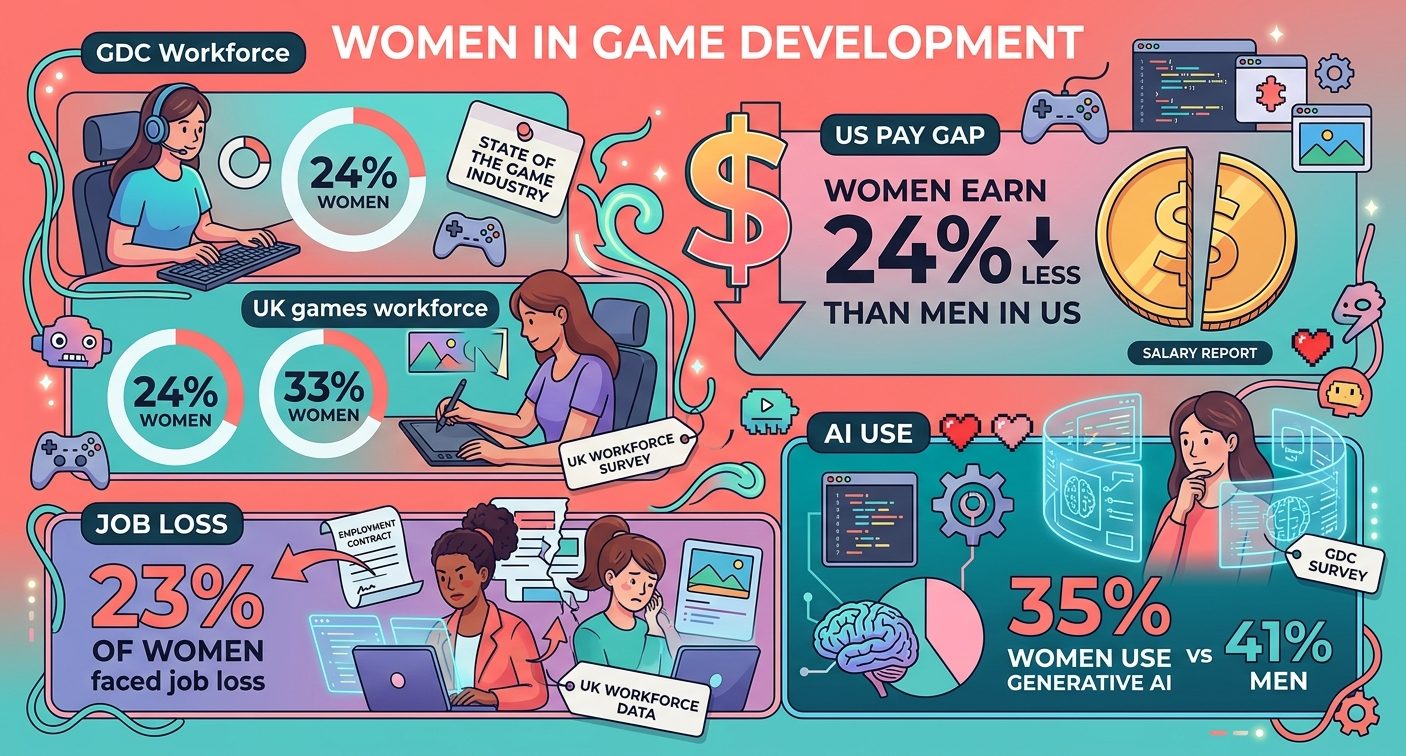
Twenty-four percent of the 2,300-plus professionals in GDC’s 2026 State of the Game Industry survey, released in January 2026, were women, and 8% were non-binary. A UK workforce survey published in July counted 33% women among its 1,610 respondents. This guide covers women in game development statistics for 2026: workforce share by survey and country, the US pay gap, job losses, AI use, and the player pipeline.
Women In Game Development Statistics 2026
What Share Of Game Developers Are Women In 2026?
Women made up 24% of respondents to GDC’s 2026 State of the Game Industry survey. Men accounted for 64% and non-binary respondents for 8%.
A further 3% preferred not to disclose, and 1% chose a gender identity not listed. The opt-in survey drew more than 2,300 professionals, with a ±3% margin of error.
GDC widened the 2026 edition to marketers, executives and investors, and US-based respondents fell to 54% from 58% in 2025. GDC says reliable year-on-year comparisons will not be available until 2027.
Source: GDC Festival of Gaming, 2026 State of the Game Industry, published January 2026
United Kingdom: 33% Women In The 2025 Survey
33% of the 1,610 people who answered the 2025 UK Games Industry Workforce Demographics Survey identified as women. Another 5% identified as non-binary or another gender.
Ukie sets that against women’s 49% share of the overall UK workforce. Around a quarter of senior leadership roles in the sample are held by women.
Responses fell from 3,603 in 2021, and Ukie advises reading the 2025 results on their own rather than as a trend.
Source: Ukie and Professor Mark Taylor, UK Games Industry Workforce Demographics Survey, responses November 2025 to January 2026, published July 2026
GDC Trend: Women And Non-Binary Share, 2022 To 2025
GDC’s 2025 report put women and non-binary developers at 32% of its sample, up from 29% in 2024 and 24% in 2022. That edition counted 25% women and 6% non-binary respondents among 3,000-plus developers.
Men were 66% of 2025 respondents, against 75% in 2020. The report gave no combined figure for 2023, so the chart plots the three years it stated.
Source: GDC, 2025 State of the Game Industry, survey of 3,000+ developers with a ±2% margin of error
23% Of Women In Ukie’s 2025 Survey Faced A Job Loss
| Group | Lost a job in the past three years |
|---|---|
| Non-binary people | 29% |
| Women | 23% |
| Men | 20% |
Source: Ukie and Professor Mark Taylor, UK Games Industry Workforce Demographics Survey, November 2025 to January 2026
Ukie counts redundancy, a workplace closing and the end of a fixed-term contract as job loss. Across all participants, 22% were affected.
The sample may have missed people who lost jobs and did not find new ones in UK games, Ukie notes. Women and non-binary respondents were also less positive than men about their workplaces and the UK industry.
GDC’s 2026 survey does not break layoffs out by gender. Overall, 28% of its respondents were laid off in the past two years, rising to 33% in the US, and yearly totals sit in these video game layoffs statistics.
Source: GDC Festival of Gaming, 2026 State of the Game Industry, January 2026
Women In Game Development Across Canada, Spain And The Netherlands
Canada, Spain and the Netherlands publish their own industry studies. Each uses its own method and period, so the figures below are reported separately.
Canada: 26% Of The Video Game Workforce
An estimated 26% of Canada’s video game workers were women in 2023-24, according to Nordicity’s study for the Entertainment Software Association of Canada. The series recorded 23% in 2021 and 19% in 2019.
On average, 62% of those women work directly on games. The industry supported 34,010 full-time equivalent jobs in 2023-24.
Source: ESAC and Nordicity, Canada’s Video Game Industry, 2023-24 data
Statistics Canada’s tax-based data, released in August 2025, gives a yearly view. Women’s share of video game employees rose from 17.8% in 2013 to 24.5% in 2021.
StatCan’s 2021 figure sits above ESAC’s 23.0% for the same year. The agency’s count covers employees, not contractors.
Source: Statistics Canada, A profile of the video game industry in the Canadian provinces, 2013 to 2021 data, released August 27, 2025
Spain: 27% Of Studio Jobs In 2024
Women’s presence in Spanish game studios rose to 27% in 2024, per DEV’s Libro Blanco 2025. The sector generated 10,508 direct jobs that year, and DEV places the women’s share above the European average.
The report also maps where those women work. 2D art accounts for 13% of them, ahead of marketing and distribution at 9% and business management at 8%.
Technical roles follow, with gameplay programming at 7% and game design at 6%.
Source: DEV, Libro Blanco del Desarrollo Español de Videojuegos 2025, 2024 data
Netherlands: 23.2% Female In 2024
23.2% of workers in the Dutch games industry identified as female in the Games Monitor 2024, up from 13.5% in 2013. Transgender, non-binary and gender-fluid workers rose from 1% reported in 2022 to 3.6% in 2024.
The industry employed 4,291 people at the end of 2023.
Source: Dutch Games Association, Games Monitor 2024 factsheet, survey fielded 2025
Where Do Women And Men Diverge In GDC’s 2026 Survey?
Men reported using generative AI tools at work more than women, 41% against 35%. Overall use across the sample stood at 36%, and the breakdown by role is in this AI in game development data.
Among employed US respondents, 18% of women and non-White participants noticed workplace changes tied to diversity, equity or free speech in the past 12 months. 10% of men said the same.
LGBTQ+ respondents reported 22% and White respondents 13%. Across all employed US respondents, 14% saw changes, 63% did not and 23% were unsure.
35% of studio workers and solo developers mainly self-fund their games. Budget benchmarks sit in this game development cost breakdown.
An owner of a California indie studio under five years old told GDC that development money is hard to find, more so for a woman. Investment totals for the sector are tracked in these gaming startup funding figures.
Source: GDC Festival of Gaming, 2026 State of the Game Industry, January 2026
The Pay Gap For Women In Game Development Sits At 24% In The US
Women in US game development earn 24% less than men, according to GDC’s 2025 Game Industry Salary Report. GDC surveyed 562 US-based professionals in July 2025, with a 3% margin of error.
Average salaries came to $155K for men and $122K for women. GDC puts the overall US gender pay gap at around 15%.
A like-for-like check narrows the group to 75 employed game designers with at least six years of experience. Within it, 68% of men earned $125,000 or more, against 38% of women and non-binary respondents.
Pay dissatisfaction runs along the same line. 60% of women and non-binary respondents feel undercompensated, compared with 50% of men.
33% of employed respondents said their company is working to close pay gaps for women and employees of color. One-tenth said no efforts are being made, about 38% did not know, and 17% said their company had no gender pay gap, including 21% of men.
Source: GDC Festival of Gaming, 2025 Game Industry Salary Report, July 2025 survey, published November 2025
Canada: Women’s Share Of Pay, 2013 To 2021
Women received 20.0% of employee compensation in Canadian video game firms in 2021, up from 14.4% in 2013. Statistics Canada notes that women’s employment share grew faster than their compensation share over the period.
Source: Statistics Canada, 2013 to 2021 data, released August 27, 2025
How Many Players Are Women, And Where Does The Gap Start?
Women were 48% of players aged 16 and over in the ESA’s Power of Play 2025 survey of 24,216 people across 21 countries, with men at 51%. Platform and genre splits are in these women gamer statistics.
Source: Entertainment Software Association, Power of Play 2025 Global Video Games Report, published October 2025
Pew Research Center’s survey of 1,423 US teens aged 13 to 17, published in May 2024, shows play and gamer identity splitting by gender.
Girls’ play also falls with age: 81% of those aged 13 to 14 play, against 67% of those aged 15 to 17. Wider age data sits in these teen gaming statistics.
| US teens aged 13 to 17 | Boys | Girls |
|---|---|---|
| Play video games | 97% | About three-quarters |
| Identify as a gamer | 62% | 17% |
Source: Pew Research Center, Teens and Video Games Today, May 2024
FAQs
What percentage of game developers are women in 2026?
About a quarter. Women were 24% of the 2,300-plus professionals in GDC’s January 2026 survey, with 8% non-binary. The UK’s 2025 workforce survey, published July 2026, recorded 33% women.
Is the share of women in game development growing?
Long-running series point upward. Statistics Canada shows women rising from 17.8% of Canadian video game employees in 2013 to 24.5% in 2021, and the Dutch Games Monitor reports 23.2% in 2024, up from 13.5% in 2013.
Do women game developers earn less than men?
Yes. GDC’s July 2025 survey of 562 US professionals found women earn 24% less than men, with average salaries of $122K against $155K. GDC puts the overall US gender pay gap near 15%.
Do Reddit claims that layoffs hit women in games harder hold up?
Partly, in UK data. Ukie’s 2025 survey found 23% of women lost a job in the past three years, against 20% of men and 29% of non-binary people. GDC’s 2026 survey does not split layoffs by gender.
What percentage of gamers are women?
48% globally. The ESA’s Power of Play 2025 survey of 24,216 players aged 16 and over in 21 countries counted 48% women and 51% men.