
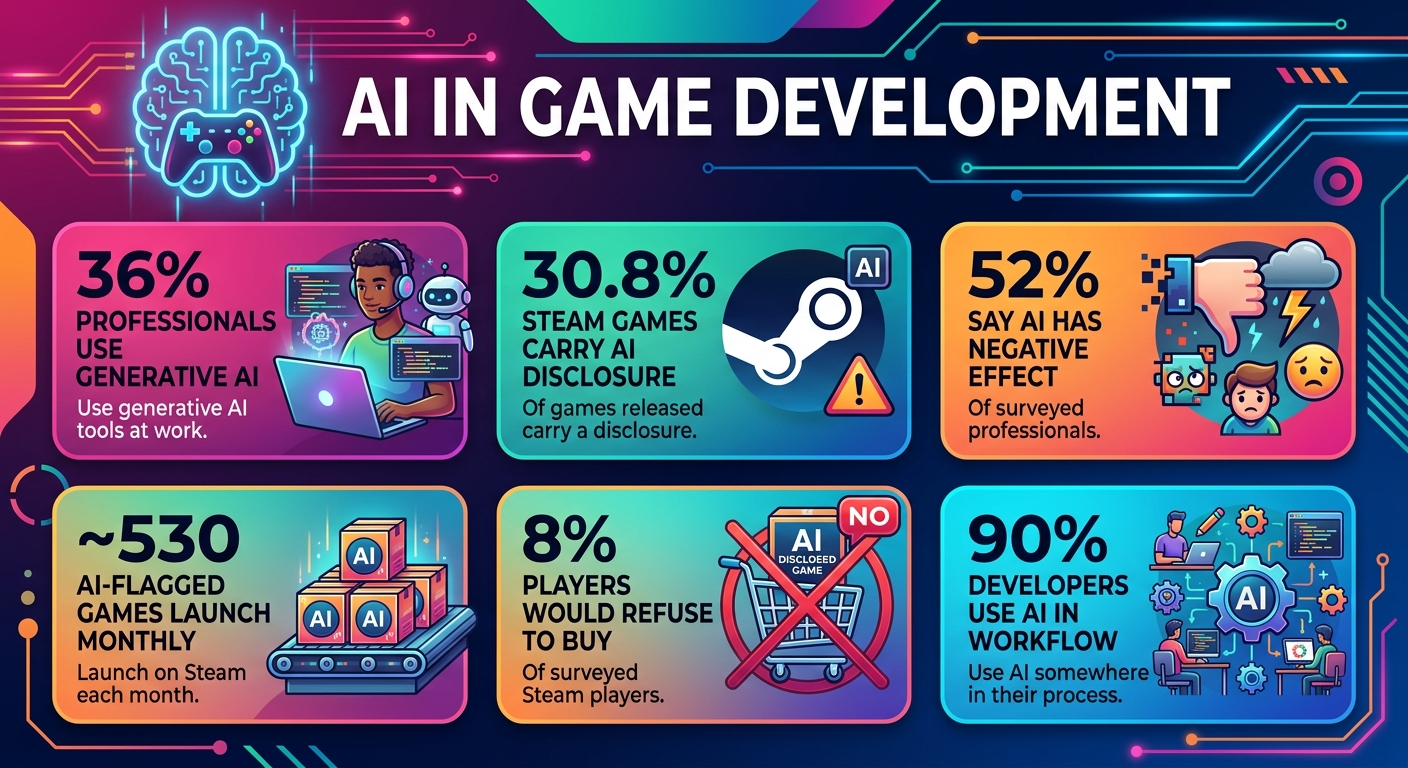
Roughly one in three new Steam games released in 2026 carries an AI disclosure. Only 36% of game industry professionals say they use generative AI at work. Both figures come from 2026 datasets, and the gap between them is the story. This post covers adoption, tasks, disclosure rates, sales performance and player reaction.
Key AI in game development statistics
How many developers use AI in game development?
Adoption drops the closer a job sits to making the game. GDC’s 2026 State of the Game Industry survey put overall generative AI use at 36% of respondents.
Staff at publishing companies, support teams and marketing or PR firms reported 58%, nearly double the 30% recorded inside game studios.
Seniority splits the same way, with upper management 18 points clear of lower-level staff.
| Group | Share using generative AI at work |
|---|---|
| Publishing, support, marketing and PR firms | 58% |
| Upper management | 47% |
| All respondents | 36% |
| Studio directors | 36% |
| Game studios | 30% |
| Lower-level staff | 29% |
Source: GDC, 2026 State of the Game Industry Survey, fielded among 2,300+ game industry professionals, published January 2026. Groups are overlapping cuts of one respondent pool, so shares do not sum.
A separate cut found 21% use internal, studio-built AI tools, rising to 30% at AAA studios.
Vendor-run surveys run far higher. Google Cloud’s Harris Poll study of 615 game developers found 90% using some form of AI in their workflows.
The two are not measuring the same thing. GDC asked a whole-workforce sample about generative AI; Google Cloud asked developers in five countries about any AI use.
AI in game development statistics by task
Use collapses as output moves closer to the shipped product. Brainstorming leads at 81%. Anything a player touches directly sits at 5%.
| Task | Share of respondents |
|---|---|
| Research or brainstorming | 81% |
| Daily tasks such as writing emails | 47% |
| Code assistance | 47% |
| Prototyping | 35% |
| Asset generation | 19% |
| Procedural generation | 10% |
| Player-facing features | 5% |
Source: GDC, 2026 State of the Game Industry Survey, published January 2026. Multi-select question; shares do not sum.
ChatGPT led the tool list at 74%, ahead of Google Gemini at 37% and Microsoft Copilot at 22%.
What other developer surveys report
Google Cloud’s respondents ranked tasks differently, with playtesting first. Localization at 45% is the highest-adoption task there with a direct effect on what ships, which tracks the cost structure behind language support and translation budgets.
| Task | Share of respondents |
|---|---|
| Playtesting and balancing | 47% |
| Localization and translation | 45% |
| Code generation and scripting support | 44% |
| Dynamic level design, animation, dialogue writing | 36% |
Source: Google Cloud and The Harris Poll, survey of 615 game development workers in the US, South Korea, Finland, Norway and Sweden, fielded June 20 to July 9, 2025.
Unity’s 2026 report, drawn from a 2025 survey of 300 developers, put back-end coding assistance at 62% and writing or narrative tasks at 44%.
Steam AI disclosure statistics
Valve added the disclosure field in January 2024. Sulka Haro’s census of 53,597 Steam releases tracked what followed.
The flagged share jumped from about 1% retroactive noise to about 7% real disclosure in a single month, then climbed steadily.
| Year | Share of that year’s releases with an AI disclosure |
|---|---|
| 2024 | 10.9% |
| 2025 | 19.9% |
| 2026, through July | 30.8% |
Source: Sulka Haro, census of 53,597 Steam releases, July 2023 to July 2026, published July 2026; annual shares as reported by PC Gamer, July 2026.
Release volume tells the same story. Non-AI launches rose modestly; AI-flagged launches went from a rounding error to the bulk of the growth.
Haro attributes 60% to 90% of the growth in monthly Steam releases to AI-flagged games, and calls a crossing of 50% in 2027 or 2028 a scenario rather than a forecast.
Disclosure is self-reported and unaudited. Haro found 22% of significant-revenue AI games added the flag after release, clustered around Valve’s January 2026 policy rewrite, so part of the 2026 rise is back-catalogue store pages being updated.
Do AI-disclosed games actually sell?
AI-flagged titles are over-represented in the release count and under-represented at the top of it. Their share of estimated sales rose, but stayed below their roughly 33% share of launches.
Controlling for launch month, an AI-flagged game reaches 100 or more reviews at about 55% of the non-AI rate. That ratio has not improved in two years, which makes the rising sales share a volume effect.
| Measure | Figure |
|---|---|
| Share of estimated sales, 2024 | 3% to 6% |
| Share of estimated sales, late 2025 to 2026 | 10% to 27% |
| Rate of reaching 100+ reviews, vs non-AI titles | 55% |
| Share of all estimated revenue taken by the top 1% of titles | 94% |
| Games in the census with zero reviews | 28% |
Source: Sulka Haro, census of 53,597 Steam releases, July 2023 to July 2026. Revenue estimated using the Boxleiter method on review counts, order-of-magnitude only.
The concentration is not an AI effect. The top 10 titles take about 62% of estimated revenue and the median reviewed game earns an estimated $300, a distribution that shapes what independent releases realistically earn.
These estimates run on review counts, so they inherit the drift documented in Steam rating and review trends. Haro calls them fine for comparisons, not for single-game earnings.
Player sentiment on AI in game development
GameDiscoverCo surveyed about 3,800 core Steam players between June 25 and July 2, 2026. Opposition is real but narrower than online argument suggests.
The 31% who react negatively shrink to 8% once the question becomes a purchase decision.
Players do read the labels: 44% check disclosures in detail, 45% glance at them, and about 11% do not engage.
Trust is thinner. Only 17% believe developers fully disclose audiovisual AI use, while 35% think only some do.
| Question | Result |
|---|---|
| Fine buying a game with an AI disclosure | 43% |
| Neutral | 26% |
| Negative reaction | 31% |
| Would not buy under any circumstance | 8% |
| Believe developers fully disclose AI use | 17% |
| Say AI coding assistants should be disclosed | 56% |
Source: GameDiscoverCo Steam Fan Snapshot, ~3,800 respondents, fielded June 25 to July 2, 2026. Opt-in giveaway sample, described by GameDiscoverCo as more committed than a typical Steam player.
Acceptance is conditional rather than blanket. About 51% of 2,100 free-text answers accepted AI for some uses but not others, with coding assistants named most often.
Bain & Company’s June 2026 survey of 5,339 gamers found 42% more comfortable with AI in games than a year earlier, rising to 59% among 13 to 17 year olds. The volume of releases those players now sort through also feeds growing unplayed game backlogs.
Developer sentiment on AI in game development
Negative sentiment among GDC respondents rose 22 points in one year. Positive sentiment nearly halved, from 13% in 2025 to 7% in 2026.
The three disciplines whose output generative models replicate most directly are the most opposed, within five points of each other.
| Discipline | Share saying generative AI has a negative impact |
|---|---|
| Visual and technical art | 64% |
| Game design and narrative | 63% |
| Game programming | 59% |
| All respondents | 52% |
Source: GDC, 2026 State of the Game Industry Survey, published January 2026.
The survey ran against a rough backdrop. GDC reported 28% of respondents were laid off in the past two years, rising to 33% in the United States.
Google Cloud’s sample raised different objections: 63% cited data ownership concerns and 32% were unsure who owns AI-generated content.
FAQs
How many game developers use AI in 2026?
36% of 2,300+ game industry professionals surveyed by GDC use generative AI at work. Google Cloud’s poll of 615 developers found 90% using some form of AI. The questions differ, which explains the gap.
What percentage of Steam games use AI?
30.8% of Steam games released in 2026 through July carry an AI disclosure, up from 19.9% in 2025 and 10.9% in 2024, based on a census of 53,597 releases. Disclosure is self-reported.
Do AI-generated games sell worse on Steam?
AI-flagged titles reach 100 or more reviews at about 55% of the non-AI rate, and that ratio has not moved in two years. Their share of estimated sales still rose, on volume rather than per-game performance.
Do Reddit threads reflect how most players feel about AI in games?
Reddit discussion skews more hostile than survey data. GameDiscoverCo found 31% of ~3,800 Steam players react negatively and 8% would refuse to buy, while 43% had no big issue.
What do developers on Reddit and in surveys use AI for most?
Research and brainstorming leads at 81% of GDC respondents. Reddit anecdotes echo the survey pattern: coding help ranks high, while asset generation sits at 19% and player-facing features at 5%.
Sources
https://www.businesswire.com/news/home/20260129438528/en/2026-State-of-the-Game-Industry-Report-Reveals-Widening-Effect-of-Layoffs-Broader-Perspectives-on-Generative-AI-Unionization-Tariffs-and-More
https://fragwyz.substack.com/p/three-years-of-ai-on-steam
https://newsletter.gamediscover.co/p/what-do-steam-fans-really-think-about
https://www.googlecloudpresscorner.com/2025-08-18-90-of-Games-Developers-Already-Using-AI-in-Workflows,-According-to-New-Google-Cloud-Research