
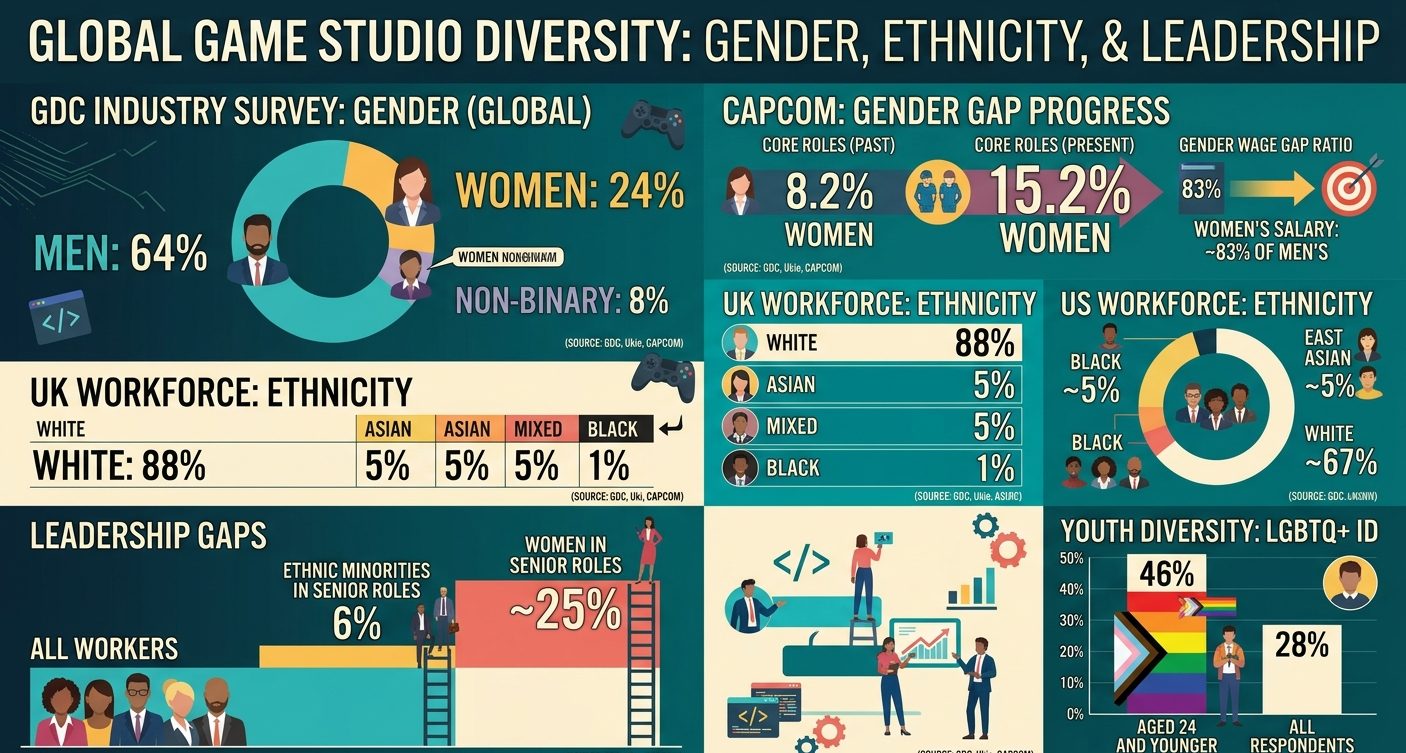
Women make up 24% of respondents in GDC’s January 2026 industry survey. In the UK’s latest workforce survey, 88% of respondents are White and 1% are Black. This guide tracks game studio diversity across gender, ethnicity, LGBTQ+ identity, seniority, pay and job losses, using GDC surveys, Ukie data, Capcom filings and Swedish company accounts.
Game Studio Diversity
How Diverse Are Game Studio Teams in 2026?
Men make up 64% of the 2,300-plus professionals in GDC’s 2026 State of the Game Industry survey. Women account for 24% and non-binary respondents for 8%.
The survey is opt-in, with a plus or minus 3% margin of error. GDC changed its method for this edition and says reliable year-on-year comparisons will not be available until 2027.
Studio workers make up 62% of respondents. Of those, 45% work at independent studios, 31% at AAA studios, 18% at AA studios and 6% at co-development studios.
Headcount and spending by studio type are covered in this game development cost breakdown.
Generative AI use also splits by gender: 41% of men use these tools at work, compared with 35% of women. Role-level data is in these AI in game development figures.
Source: GDC Festival of Gaming, 2026 State of the Game Industry, January 2026
The UK’s 2025 workforce survey counted 33% women and 5% non-binary or another gender among 1,610 respondents. Women make up 49% of the wider UK workforce.
Country-by-country splits sit in our women in game development statistics.
Source: Ukie and Professor Mark Taylor, UK Games Industry Workforce Demographics Survey, November 2025 to January 2026
Which Studio Disciplines Skew Most Male?
GDC’s 2025 salary report breaks down gender by discipline among US respondents. Men make up 79% of audio respondents and 77% of programming respondents.
Business and marketing is the only discipline where men fall below half, at 49%. The report labels the remainder “Female/NB” for most roles but “Female” for programming and visual arts.
Source: GDC Festival of Gaming, 2025 Game Industry Salary Report, July 2025 survey of 562 US-based professionals
Game Studio Diversity by Race: 88% White in the UK Sample
| Ethnic group | Share of UK survey respondents |
|---|---|
| White | 88% |
| Mixed or multiple ethnicities | 5% |
| Asian | 5% |
| Black | 1% |
Source: Ukie, UK Games Industry Workforce Demographics Survey, November 2025 to January 2026
Black respondents make up 1% of the UK sample, against 5.45% of the broader UK workforce. Asian respondents also trail the working-age population’s 7.4%, according to Ukie.
GDC limited its 2026 ethnicity question to US residents because it judged its international pool too small to represent diversity outside the US.
Two-thirds of US-based GDC respondents identify as White or Caucasian. Black and East Asian respondents are 5% each, and South Asian respondents are 1%.
Source: GDC Festival of Gaming, 2026 State of the Game Industry, US-based respondents, January 2026
Why Does Diversity Shrink at Senior Studio Levels?
In the Ukie data, White British representation rises as roles become more senior. Ethnic minorities hold 6% of senior leadership roles at organisations with more than 24 employees.
Women hold around a quarter of senior leadership roles. The LGBTQIA+ share falls to a minimum of 15% in senior leadership at larger companies, compared with 33% across all respondents.
Source: Ukie, UK Games Industry Workforce Demographics Survey, November 2025 to January 2026
Capcom: Women in Core Positions Rose to 15.2%
Women’s share of Capcom’s workforce stayed between 21.0% and 21.5% from the year ended March 2021 to the year ended March 2025. Over the same period, the share of women in core positions rose from 8.2% to 15.2%.
Women held 11.9% of Capcom’s managerial positions at March 31, 2025. Its foreign employees came from 36 countries.
Source: Capcom, Mid-to-Long Term Growth Strategies and Integrated Report 2025, non-consolidated permanent employees, years ended March 31, 2021 to 2025
The 24% Gender Pay Gap and Game Studio Diversity
Women in US game companies earn 24% less than men, and non-white workers earn 27% less than white peers. The figures come from GDC’s survey of 562 US professionals in July 2025.
Average salaries were $155K for men and $122K for women. White respondents averaged $150K, compared with $114K for non-white respondents.
GDC also compared 75 employed game designers with six or more years of experience. Within that group, 68% of men earned at least $125K, compared with 38% of women and non-binary respondents.
60% of women and non-binary respondents feel undercompensated, against 50% of men. Among non-white workers the figure is 62%, against 50% of those identifying solely as white.
33% of employed respondents said their company is working to close pay gaps, and 38% did not know. 17% said their company had no gender pay gap, including 21% of men.
Source: GDC Festival of Gaming, 2025 Game Industry Salary Report, July 2025 survey, published November 2025
Capcom’s Wage Ratio Against an 88% Target
Women’s average salary at Capcom was 82.8% of men’s in the year ended March 2025. The ratio peaked at 85.4% two years earlier.
Capcom has set a target of 88% or better by the end of March 2029.
Source: Capcom, Mid-to-Long Term Growth Strategies, gender wage gap ratio for regular employees, years ended March 31, 2021 to 2025
Who Lost Jobs? Layoff Exposure by Identity
| Group | Lost a job in the past three years |
|---|---|
| Trans | 30% |
| Non-binary | 29% |
| LGBTQIA+ | 26% |
| Women | 23% |
| Men | 20% |
| Cis | 20% |
| Straight | 18% |
Source: Ukie, UK Games Industry Workforce Demographics Survey, November 2025 to January 2026
Across all UK respondents, 22% were affected by a job loss. Ukie’s definition covers redundancy, workplace closures and the end of fixed-term contracts.
Ethnic minorities were also more likely than White British people to have lost a job. Ukie notes that the sample likely missed people who did not find new work in UK games.
In GDC’s 2026 survey, 28% of respondents were laid off in the past two years, rising to 33% in the US. Yearly totals are tracked in these video game layoffs statistics.
Source: GDC Festival of Gaming, 2026 State of the Game Industry, January 2026
LGBTQ+ Representation Reaches 46% Among the Youngest Developers
| GDC 2026 group | Identify as LGBTQ+ |
|---|---|
| All respondents | 28% |
| Living in the US | 31% |
| Aged 18-34 | 39% |
| Aged 24 and younger | 46% |
Source: GDC Festival of Gaming, 2026 State of the Game Industry, January 2026
The youngest cohort is small: only 6% of 2026 respondents were aged 18-24. GDC’s 2025 edition reported 24% LGBTQ+ overall and 43% among 18-24s, but GDC advises against comparing the two editions directly.
Ukie found 33% LGBTQIA+ representation among UK respondents. The most recent estimate for lesbian, gay and bisexual people among UK over-16s is 3.7%. Trans respondents made up 6% of the UK sample.
Source: Ukie, UK Games Industry Workforce Demographics Survey, November 2025 to January 2026
Do Studio Workers Notice DEI Changes?
GDC asked employed US respondents whether they had noticed changes at work related to diversity and equity or free speech. 22% of LGBTQ+ respondents and 18% of women and non-White participants said they had.
The share was 10% among men and 13% among White respondents. Across all employed US respondents, 14% saw changes, 63% did not and 23% were unsure.
Source: GDC Festival of Gaming, 2026 State of the Game Industry, January 2026
In the UK, 70% of respondents call their employer a great place to work, but only 38% say the same of the UK games industry. Women and non-binary respondents were less positive than men on both measures.
Ukie’s Raise The Game programme plans an action plan backed by a dedicated fund. As of the July 2026 summary, the plan had not yet been published.
Source: Ukie, UK Games Industry Workforce Demographic Survey Executive Summary, July 2026
Sweden’s 23.5% and the 46% Player Benchmark: Game Studio Diversity Gaps
Women held about 2,150 of 9,130 jobs at Swedish game companies in 2024, a 23.5% share. The figure comes from company annual accounts, not a survey, and stood at 21% in 2019.
At Swedish companies with more than 100 employees, women made up more than a quarter of staff.
Source: Dataspelsbranschen, Game Developer Index 2024 (2019-2023 data) and Swedish Games Industry 2025 (2024 data)
Players are a different measure. The ESA’s 2026 report puts women at 46% of active US players and men at 53%, with women ahead among Boomers, 52% to 47%.
Platform and genre splits are in these women gamer statistics.
Source: Entertainment Software Association with YouGov, 2026 Essential Facts About the U.S. Video Game Industry, June 2026
FAQs
What percentage of game developers are women?
About a quarter. Women made up 24% of the 2,300-plus respondents in GDC’s January 2026 survey, with another 8% non-binary. The UK’s 2025 workforce survey recorded 33% women.
How racially diverse are game studios?
Not very. Among US-based respondents in GDC’s 2026 survey, 67% are White and 5% are Black. In the UK’s 2025 survey, 88% of respondents are White and 1% are Black.
Is there a pay gap in the game industry?
Yes. GDC’s July 2025 survey of 562 US professionals found women earn 24% less than men and non-white workers earn 27% less than white peers. Average salaries were $155K for men and $122K for women.
Is Reddit right that many young game developers are LGBTQ+?
The survey data backs it. In GDC’s 2026 survey, 46% of respondents aged 24 and younger identify as LGBTQ+, compared with 28% of all respondents. Ukie’s UK survey recorded 33%.
Do layoffs hit underrepresented game workers harder?
In UK data, yes. Ukie found 29% of non-binary people, 23% of women and 20% of men lost a job in the past three years. LGBTQIA+ respondents reported 26%, against 18% of straight respondents.
Sources:
https://www.capcom.co.jp/ir/english/assets/pdf/management/strategy_mid_term_obj.pdf