
Five research firms size this category and their base values run from $15.7 billion to $36.21 billion. The gap is definitional: “educational games” and “game-based learning” draw different boundaries around overlapping products. This page collects verified educational games statistics covering market size forecasts, regional revenue share, segment leaders, Duolingo’s reported user and revenue figures, and what US players say games teach them.
Educational Games Statistics
How Big Is The Educational Games Market In 2026?
Each figure below is vendor revenue measured under that firm’s own scope definition, not a user count. Two firms measure “educational games” and three measure “game-based learning”.
IMARC Group publishes the lowest growth rate in the group at 14.59%. Market.us publishes the highest at 22.6%.
| Research firm | Category measured | Base value | Forecast | Published CAGR |
|---|---|---|---|---|
| USD Analytics | Educational games | $15.70bn (2025) | $92.60bn (2034) | 21.8% |
| Market.us | Educational games | $17.34bn (2025) | $133.03bn (2035) | 22.6% |
| IMARC Group | Game-based learning | $24.50bn (2025) | $88.60bn (2034) | 14.59% |
| Mordor Intelligence | Game-based learning | $34.90bn (2026) | $80.22bn (2031) | 18.11% |
| Fortune Business Insights | Game-based learning | $36.21bn (2026) | $181.79bn (2034) | 22.34% |
Source: USD Analytics (Feb 2025); Market.us (Feb 2026); IMARC Group (2026-2034 forecast); Mordor Intelligence (Jan 2026 update, 2026-2031 forecast); Fortune Business Insights (report updated Aug 31, 2026)
Fortune Business Insights is the only firm in the set publishing consecutive years, at $29.59 billion for 2025 and $36.21 billion for 2026. Mordor Intelligence also publishes both, at $29.46 billion and $34.90 billion.
Educational Games Statistics By Region
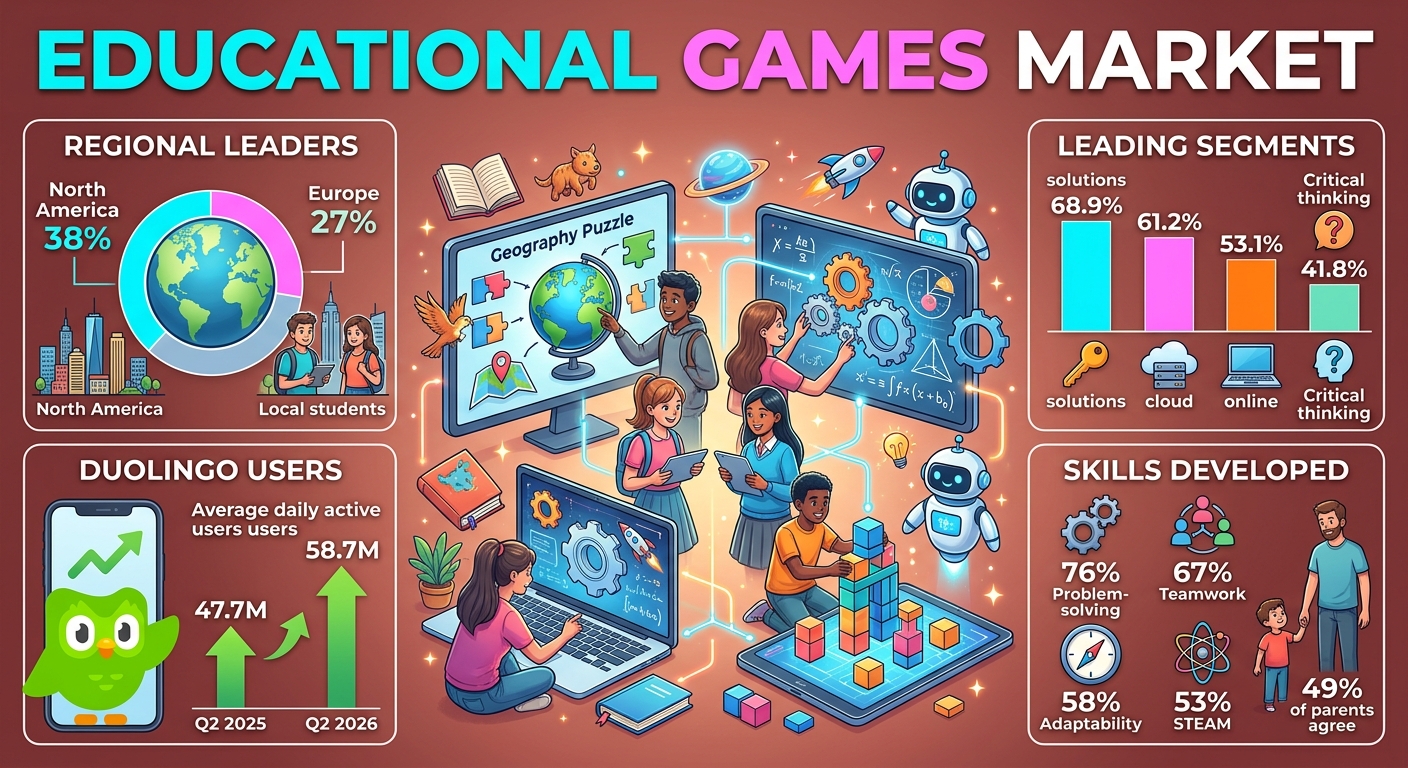
Fortune Business Insights splits 2025 game-based learning revenue across four regions that total 100%. North America leads at 38%.
| Region | Share of 2025 game-based learning revenue |
|---|---|
| North America | 38% |
| Europe | 27% |
| Asia-Pacific | 25% |
| Rest of World | 10% |
Source: Fortune Business Insights, Game Based Learning Market, 2025 revenue share
Market.us reads North America higher because it measures a narrower category. It records 43.5% of 2025 educational games revenue in North America, worth $7.54 billion, with the United States alone at $6.76 billion and a 20.52% CAGR. The two readings are 5.5 percentage points apart and are not interchangeable.
Fortune Business Insights separately assigns the United States nearly 34% of global game-based learning revenue. For context on where play time already sits, these mobile and console revenue comparisons track the same platform shift.
Which Segments Lead The Educational Games Market?
Market.us reports a leading segment for each of six segmentation cuts. Every bar below is a share of the same 2025 global educational games revenue, measured under a different cut, so the figures cannot be added together.
| Segmentation cut | Leading segment | Share of 2025 revenue |
|---|---|---|
| Component | Solutions | 68.9% |
| Deployment mode | Cloud | 61.2% |
| Platform | Online | 53.1% |
| Application | Critical thinking and problem-solving | 41.8% |
| Game type | Location-based games | 29.4% |
| End user | Education institutions | 24.9% |
Source: Market.us, Educational Games Market, February 2026, 2025 revenue shares
Education institutions take 24.9% of end-user revenue, the smallest leading share in the set. Schools are not where most of the money sits. Market.us also reports that more than 410,000 educational institutions worldwide have incorporated educational games, and that 67% of US K-12 schools use educational gaming tools in curriculum delivery.
How Many People Use Duolingo?
Duolingo is the largest listed pure-play in the category and files quarterly. Daily active users are an average across the measurement period, not a headcount at a single moment.
| Metric | Q2 2025 | Q2 2026 | Change |
|---|---|---|---|
| Daily active users | 47.7M | 58.7M | +23% |
| Monthly active users | 128.3M | 140.6M | +10% |
| Paid subscribers (period end) | 10.9M | 12.7M | +17% |
| Revenue | $252.3M | $298.5M | +18% |
Source: Duolingo Q2 2026 Shareholder Letter, three months ended June 30, 2026
Subscriptions supplied $258.04 million of the $298.45 million quarter. In-app purchases fell to $8.00 million from $10.39 million a year earlier.
Duolingo also disclosed a current user retention rate of 84%, an all-time high, and a one-time June campaign in which 15.4 million learners restored a lapsed streak. Nearly 8 million of those had no active streak when the event started.
Educational Games Statistics On Skills And Parents
ESA ran a 20-minute online survey with YouGov from February 11 to 25, 2026, among 13,545 respondents recruited from YouGov’s panel, weighted to the US population. Respondents could agree with more than one skill statement, so these shares do not sum to a total.
| Skill adults agree games help develop | Share of US adults agreeing |
|---|---|
| Problem-solving | 76% |
| Teamwork and collaboration | 67% |
| Adaptability and resilience | 58% |
| STEAM skills | 53% |
| Communication | 52% |
Source: Entertainment Software Association, 2026 Essential Facts About the U.S. Video Game Industry, fieldwork February 11-25, 2026
Parents read lower. ESA found 49% of parents whose children play believe games teach important skills such as problem solving and creative thinking, against the 76% of adults agreeing on problem-solving. Two thirds of parents use parental controls, rising to 70% for parents of children aged 12 and under.
Among the same 2026 respondents, 75% of American parents play weekly and 81% of those say they play with their children, 52% of them at least weekly. Play patterns behind the parent figures appear in these teen gaming habits and in the broader video game industry figures.
K-12 Educational Games Statistics And Platform Demand
Technavio forecasts the K-12 game-based learning market to grow by $37,346.9 million between 2026 and 2030 at a 27.7% CAGR. That is incremental revenue over the period, not a market size.
Roblox opened its Learning Hub to all users on July 22, 2025. In the launch announcement, Sesame Workshop reported its STEM title Sesame Street Mecha Builders had already drawn 70 million visits, a visit count rather than a user count. Platform scale is covered in these Roblox engagement numbers.
Mobile is where classroom-adjacent play happens. ESA’s 2026 report found mobile the most popular device across all age groups at 80%, and puzzle the top genre on mobile at 66%. Hardware economics for immersive learning still track VR headset ownership, while production costs are shifting with AI in game development.
Fortune Business Insights names K-12 education its leading application segment and simulation-based games its leading game type for 2025. Store-level revenue context sits in these app store gaming revenue figures.
FAQs
How big is the educational games market in 2026?
Fortune Business Insights values game-based learning at $36.21 billion in 2026. Market.us values the narrower educational games category at $17.34 billion in 2025. The two firms measure different scopes, so the figures are not comparable.
How many Americans play video games every week?
212.3 million Americans aged 5 to 90 play video games weekly, up 3%, or 7.2 million, on ESA’s 2025 report. That equals 67% of Americans in that age range playing one or more hours per week.
How many daily active users does Duolingo have?
Duolingo averaged 58.7 million daily active users across the three months ended June 30, 2026, up 23% year on year. Monthly active users averaged 140.6 million and paid subscribers reached 12.7 million at period end.
Do parents think video games teach their children useful skills?
49% of American parents whose children play video games believe games teach important skills such as problem solving and creative thinking, per ESA’s 2026 survey. Separately, 76% of US adults agree games help develop problem-solving skills.
What do Reddit threads say about educational games?
Reddit discussion is self-selected anecdote, not measured data, and no figure on this page comes from it. For measured findings, use ESA’s weighted YouGov survey or company filings such as Duolingo’s quarterly shareholder letters.
Sources
https://www.theesa.com/two-thirds-of-americans-play-video-games-every-week-according-tonew-report-from-the-entertainment-software-association/
https://www.sec.gov/Archives/edgar/data/1562088/000162828026053299/q2fy26duolingo6-30x26share.htm
https://www.fortunebusinessinsights.com/game-based-learning-market-116405
https://market.us/report/educational-games-market/
https://www.lingobright.com/statistics/duolingo-user-and-revenue/
https://icon-era.com/statistics/video-game-statistics/