
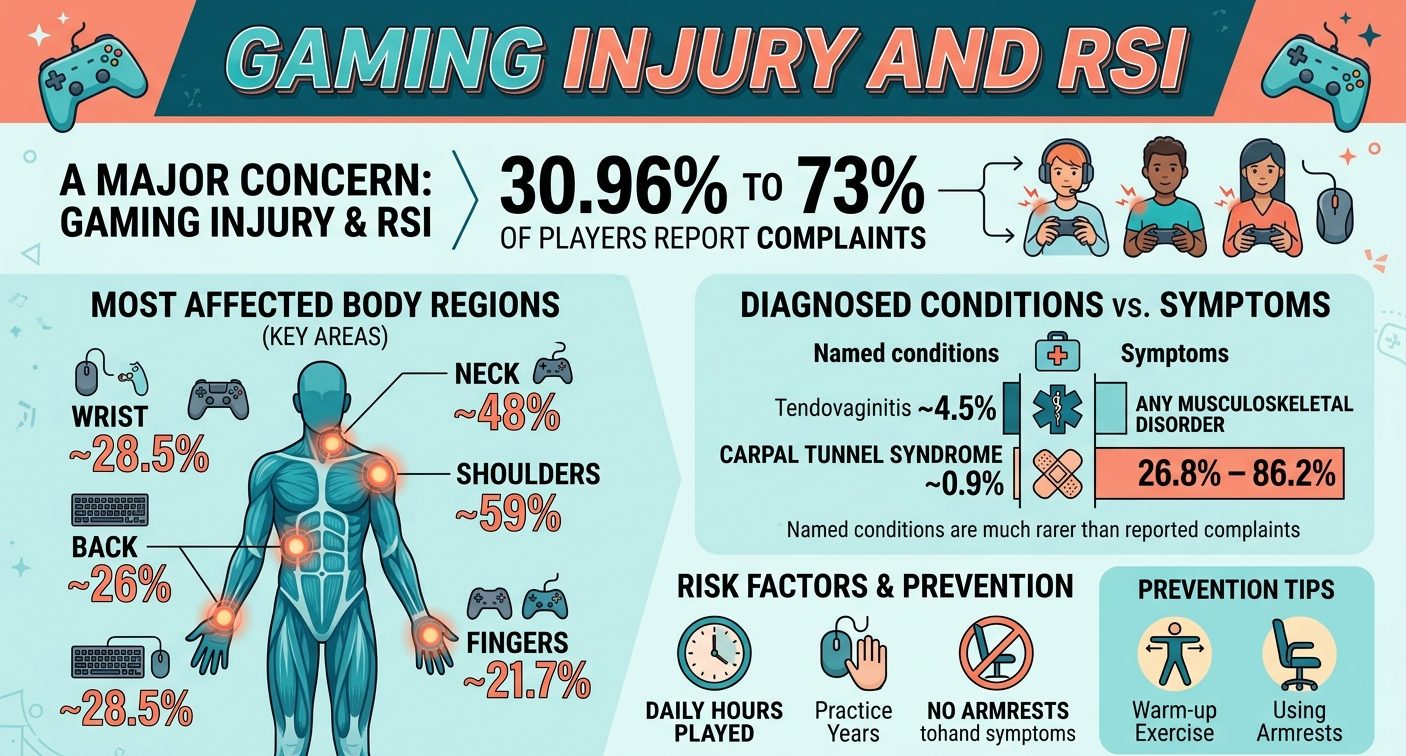
Four peer-reviewed studies published between January and May 2026 put gaming injury and RSI complaints anywhere from 30.96% to 73% of players. The spread is a measurement problem, not a disagreement: each counted something different over a different window. This page sets out every figure with its sample, its recall period and the source that published it.
Gaming Injury And RSI Statistics: Key Figures
How Common Is Gaming Injury And RSI?
Injury and pain sit at different thresholds, and no two of these studies asked the same question. Reading them side by side means reading what each one counted.
The seven-day figure of 44% and the 60% point prevalence sit in an order that looks backwards, since a single-day snapshot would normally fall below a seven-day recall window. Recruitment explains more than player health does: the Science & Sports sample was 91% casual players recruited through social media, while the pooled sample drew on competitive cohorts. Competitive rosters, the population behind tournament prize pool growth, are a minority in all four datasets.
Within the pooled analysis, the spine was the most affected region at 41% (95% CI 0.26–0.55), neck pain reached 48% (95% CI 0.26–0.70) and the upper extremities 31%. Heterogeneity was high for both regional estimates.
Source: Sports Medicine – Open, “Do Esports Players Experience Pain?”, systematic review and meta-analysis, published 3 January 2026.
Gaming Injury And RSI By Body Region
Two 2026 datasets rank the body regions differently, and the denominators are not the same. The Sports figures are shares of all 1,229 respondents; the Scientific Reports figures are shares of reported injuries.
| Body region | Athletes affected | Share of 1,229 e-athletes |
|---|---|---|
| Trunk and spine | 319 | 26.0% |
| Fingers | 267 | 21.7% |
| Wrist | 225 | 18.3% |
| Thumb | 76 | 6.2% |
Source: Sports, “Injuries and Overuse Injuries in Esports”, 1,229 e-athletes surveyed August 2022 to August 2023, published 24 March 2026. Regions overlap and do not sum to a whole.
Where Brazilian Players Reported Injuries
The wrist tops the Brazilian ranking and the low back drops to second. Daily exposure differs sharply: men in that sample played 5.83 ± 3.38 hours a day and women 4.63 ± 3.03 hours, at a median of six days a week, against a mean of 21.0 ± 16.4 hours a week in the Sports cohort.
| Body region | Share of reported injuries |
|---|---|
| Wrist | 28.49% |
| Low back | 20.00% |
| Hands | 18.35% |
| Fingers | 15.89% |
Source: Scientific Reports, “Prevalence of musculoskeletal injuries and associated risk factors in Brazilian esports players”, 365 players, data collected November 2019 to November 2020, published 7 March 2026.
Genre mix moves in the same direction. Tactical shooter players in the Sports cohort reported significantly more injuries than sports game players (p = 0.021) and MMO players (p = 0.042), and the titles carrying the largest competitive audiences are tracked in the esports viewership rankings.
Which Gaming Injury And RSI Diagnoses Get Recorded?
Named conditions are far rarer than reported complaints. Tendovaginitis, an inflammation of the tendon sheath, was the most frequent diagnosis at five times the rate of carpal tunnel syndrome.
| Condition | Athletes affected | Share of 1,229 |
|---|---|---|
| Tendovaginitis | 55 | 4.5% |
| Finger tendon injuries | 52 | 4.2% |
| Wrist contusions | 30 | 2.4% |
| Finger contusions | 11 | 0.9% |
| Carpal tunnel syndrome | 11 | 0.9% |
| Finger fractures | 9 | 0.7% |
| Finger dislocations | 4 | 0.3% |
Source: Sports, 1,229 e-athletes surveyed August 2022 to August 2023, published 24 March 2026. A player may appear under more than one condition.
Carpal tunnel syndrome, the condition most often attached to gaming in popular coverage, is the rarest named diagnosis in that dataset at 0.9%. Clinical screening produces a different picture. Basuodan’s survey of 95 Saudi esports athletes recorded carpal tunnel syndrome in 15%, against 4% in a non-esports control group.
Source: Journal of Experimental Orthopaedics, systematic review of 10 studies, published 25 May 2026, citing Basuodan et al. (2023).
Gaming Injury And RSI Risk Factors
Exposure is statistically significant and practically weak. Every association below comes from the same Brazilian cohort, so the odds ratios are directly comparable with one another.
| Injury site | Factor | Odds ratio | p |
|---|---|---|---|
| Wrist | Each additional year of practice | 1.110 | 0.005 |
| Wrist | Each additional practice day per week | 1.183 | 0.032 |
| Shoulder | Each additional year of practice | 1.120 | 0.002 |
| Shoulder | Each additional practice day per week | 1.175 | 0.036 |
| Low back | Each additional year of practice | 1.105 | <0.011 |
| Neck | Each additional hour played per day | 1.081 | 0.049 |
Source: Scientific Reports, 365 Brazilian esports players, data collected November 2019 to November 2020. Wrist figures from multiple logistic regression; remaining figures from simple binary logistic regression.
The wrist model explained 4.7% to 6.7% of the variance in who got hurt, and every ROC curve returned an AUC below 0.70, so the authors declined to set cutoff points for risk stratification. Hours alone do not identify the injured player.
The 35-Hour Threshold And Armrests
Two ergonomic findings in the 2026 review are sharper. Ekefjärd’s survey of 40 esports athletes linked more than 35 hours of weekly gaming to eightfold odds of physical symptoms (OR 8.0; 95% CI 1.4–44.6; p = 0.018), though the interval is wide. Basuodan found radiating hand symptoms exclusively among athletes who did not use armrests (27.27%), with none reported by armrest users.
Warm-up practice is rare. Only 140 of 1,229 e-athletes (11.4%) warmed up before gaming, averaging 2.3 ± 8.9 minutes. Hours spread across many titles are not the same as 35 hours in one input pattern, a distinction visible in session length data by age group and in the wider player base figures.
Source: Journal of Experimental Orthopaedics, systematic review of 10 studies and 789 e-athletes, published 25 May 2026; Sports, 1,229 e-athletes, published 24 March 2026.
Gaming Injury And RSI Prevalence Ranges Across 10 Studies
The 2026 systematic review pooled 10 studies covering 789 e-athletes and reported ranges rather than single figures. Participants per study ran from 39 to 188, and the searches closed on 28 August 2025.
| Measure | Reported range |
|---|---|
| Any musculoskeletal disorder | 26.8% – 86.2% |
| Eye fatigue | 32.5% – 92% |
| Lower back | 4.7% – 63.8% |
| Shoulders | 2.7% – 59% |
| Neck | 11.3% – 50% |
| Wrists | 8% – 44.8% |
| Fingers | 2.5% – 38% |
| Hands | 5% – 30% |
| Elbow | 4.7% – 12.9% |
| Time loss from esports | 4.6% – 23.3% |
| Physician contacts | 2% – 6.9% |
Source: Journal of Experimental Orthopaedics, “Musculoskeletal disorders in eSports athletes: A systematic review”, 10 studies and 789 e-athletes, published 25 May 2026.
The consultation figures are the tightest numbers in the table and the most telling. At most 6.9% of athletes saw a clinician, against a floor of 26.8% reporting some disorder. Time loss from esports tops out at 23.3%, so players withdraw from play more often than they seek treatment.
The review’s authors note that most included studies relied on self-reported symptoms rather than confirmed diagnoses, and that DiFrancisco-Donoghue found the injury pattern across hands, wrists, eyes and neck resembles what is seen in sedentary office workers. Professionalisation has outpaced medical provision: the sport now fills arenas, as the tournament attendance figures show, while structured screening remains uncommon.
FAQs
Can gaming cause repetitive strain injury?
Yes. Sports recorded 19.6 injuries per 1,000 gaming hours among 1,229 e-athletes, with tendovaginitis in 4.5% and finger tendon injuries in 4.2%. The authors describe degenerative and overuse damage as the dominant pattern.
How common is carpal tunnel syndrome among gamers?
11 of 1,229 e-athletes (0.9%) reported it in Sports, March 2026. Basuodan’s survey of 95 Saudi esports athletes recorded 15%, against 4% in a non-esports control group. Screening method drives the difference.
Which body part is affected most by gaming injury and RSI?
It depends on the sample. Trunk and spine led in Sports at 26.0% of 1,229 e-athletes. The wrist led in Scientific Reports at 28.49% of reported injuries among 365 Brazilian players.
How many hours of gaming raises injury risk?
Ekefjärd’s survey of 40 esports athletes linked more than 35 weekly hours to eightfold odds of physical symptoms (OR 8.0; 95% CI 1.4–44.6; p = 0.018). The confidence interval is wide.
Why do Reddit threads about gaming injuries focus on carpal tunnel?
The research does not match that focus. Carpal tunnel syndrome appeared in 0.9% of 1,229 e-athletes in Sports, March 2026, while tendovaginitis reached 4.5% and finger tendon injuries 4.2%.
Sources
https://www.mdpi.com/2075-4663/14/4/127
https://www.nature.com/articles/s41598-026-41487-2
https://pmc.ncbi.nlm.nih.gov/articles/PMC13239912/
https://link.springer.com/article/10.1186/s40798-025-00971-1
https://icon-era.com/statistics/average-gaming-session-length-by-age-group/