
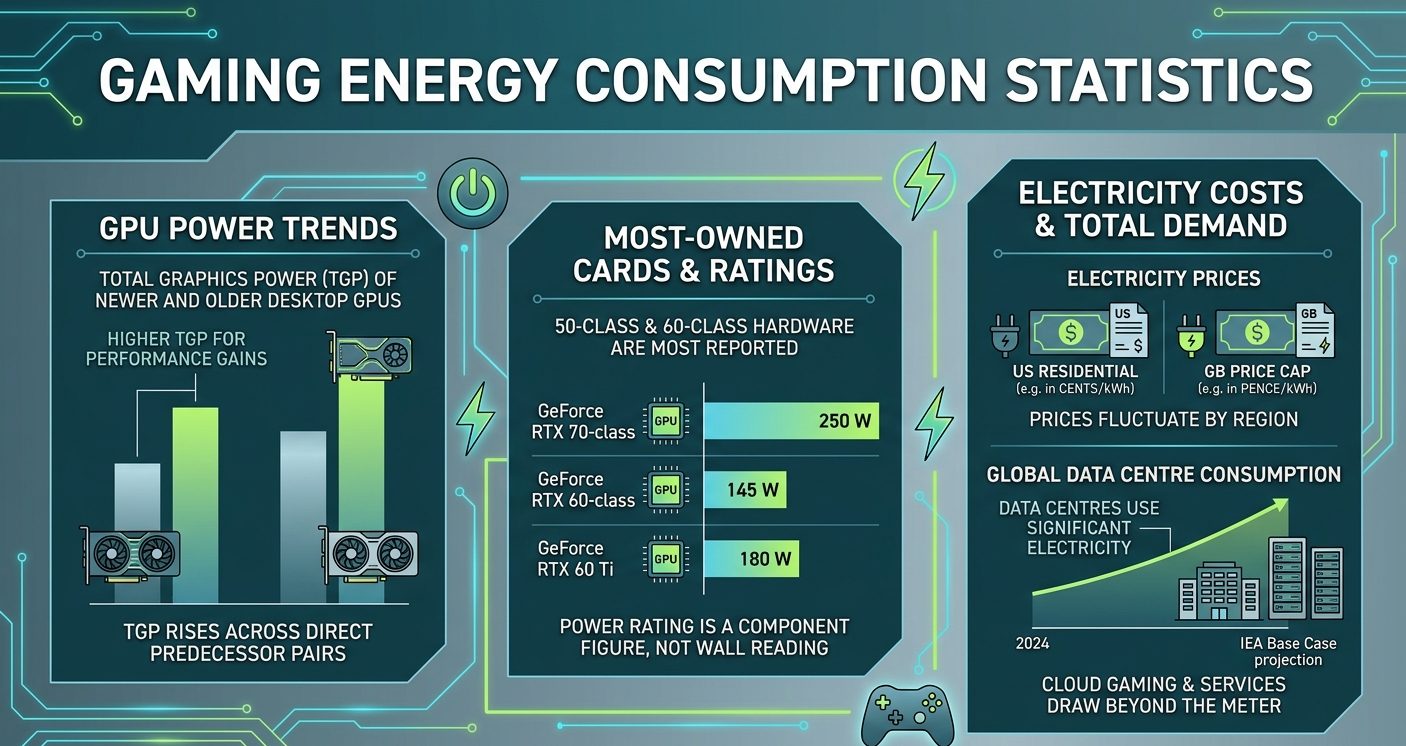
Gaming energy consumption is measurable in three places in 2026: the board power NVIDIA prints on its own spec sheets, the share of players who actually own each card, and the price utilities charge per kilowatt-hour. Every number below was pulled from the organisation that published it, with its exact period attached.
Gaming Energy Consumption
Gaming Energy Consumption By GPU: What The Most-Owned Cards Are Rated To Draw
Steam’s hardware survey is opt-in. It describes the systems whose owners accepted the survey prompt, not the whole PC gaming population, and Valve resamples every month.
In August 2026 the RTX 3060 led at 3.92%, with the RTX 4060 Laptop GPU second at 3.84%. Ten of the fifteen most-reported parts are 50-class or 60-class hardware.
Seven of those top-fifteen entries are RTX 40 or RTX 50 desktop cards. The table pairs each one with the board power NVIDIA publishes for it. Laptop parts are excluded because the laptop maker sets their power envelope, not NVIDIA.
| GPU | Steam share, Aug 2026 | NVIDIA total graphics power |
|---|---|---|
| GeForce RTX 5070 | 3.77% | 250 W |
| GeForce RTX 4060 | 3.60% | 115 W |
| GeForce RTX 5060 | 3.16% | 145 W |
| GeForce RTX 5060 Ti | 2.55% | 180 W |
| GeForce RTX 4060 Ti | 2.37% | 165 W or 160 W |
| GeForce RTX 5070 Ti | 1.82% | 300 W |
| GeForce RTX 4070 | 1.78% | 200 W |
Source: Steam Hardware & Software Survey, August 2026 (share of surveyed systems); NVIDIA GeForce product specifications, Founders Edition or reference design. NVIDIA lists two figures for the RTX 4060 Ti: 165 W for the 16 GB model and 160 W for the 8 GB model.
Total graphics power covers the card. The processor, memory, drives, fans and monitor sit outside it, which is why a card rating is a component figure rather than a wall reading. Broader context on who owns what sits in these PC gaming statistics.
The RTX 5090 and RTX 5080 are both outside the top fifteen, at 0.43% and 1.71%. High-rated flagship cards are a small slice of the surveyed base, a pattern that also shows up in older hardware still in regular use.
Gaming Energy Consumption By Generation: Blackwell Versus Ada Board Power
NVIDIA raised its published board power in every desktop pair that has a direct predecessor. The gap is widest on the 60-class and narrowest on the 70 Ti-class.
| Class | Blackwell card | TGP | Ada card | TGP |
|---|---|---|---|---|
| 70 Ti | RTX 5070 Ti | 300 W | RTX 4070 Ti | 285 W |
| 70 | RTX 5070 | 250 W | RTX 4070 | 200 W |
| 60 Ti | RTX 5060 Ti | 180 W | RTX 4060 Ti (8 GB) | 160 W |
| 60 | RTX 5060 | 145 W | RTX 4060 | 115 W |
Source: NVIDIA GeForce RTX 5070 Family, RTX 5060 Family, RTX 4070 Family and RTX 4060 Family specifications, product pages as published 2026. Figures represent NVIDIA’s Founders Edition or reference design; add-in-card models vary.
Required system power moves with it. NVIDIA specifies 650 W for the RTX 5070 and 750 W for the RTX 5070 Ti, both measured on a PC configured with a Ryzen 9 9950X.
What Does NVIDIA’s “Average Gaming Power” Measure?
On its Ada pages NVIDIA publishes a second figure alongside TGP, measured across 22 games at 4K, 1440p and 1080p. The RTX 4070 is listed at 186 W average gaming power against 200 W TGP, and the RTX 4060 at 110 W against 115 W.
NVIDIA does not publish an equivalent average gaming power figure on its Blackwell product pages, so the two generations can only be compared on TGP. Device-level efficiency comparisons outside gaming are handled in this ChromeOS versus Windows power consumption breakdown.
Which GPUs Are Gaining Share On Steam?
All four Blackwell desktop cards inside the August top fifteen gained share between April and August 2026. The RTX 5070 added the most, moving from 3.01% to 3.77%.
Laptop parts moved differently. The RTX 4060 Laptop GPU sat at 4.02% in June, ahead of the desktop RTX 3060 at 3.88%, then fell to 3.64% in July before recovering to 3.84% in August.
| GPU | Apr 2026 | May 2026 | Jun 2026 | Jul 2026 | Aug 2026 |
|---|---|---|---|---|---|
| RTX 5070 | 3.01% | 3.09% | 3.29% | 3.62% | 3.77% |
| RTX 5060 | 2.71% | 2.58% | 2.81% | 3.03% | 3.16% |
| RTX 5060 Ti | 1.90% | 2.06% | 2.26% | 2.40% | 2.55% |
| RTX 5070 Ti | 1.70% | 1.73% | 1.76% | 1.78% | 1.82% |
| RTX 5060 Laptop GPU | 1.71% | 1.83% | 2.48% | 2.19% | 2.66% |
Source: Steam Hardware & Software Survey, monthly figures as displayed in the August 2026 release. Shares are of surveyed systems, not of PC gamers or units shipped.
Gaming Energy Consumption Cost: US And UK Electricity Prices In 2026
The EIA does not collect retail rates directly. It divides reported revenue by reported sales volume and publishes the result as a proxy for what customers pay.
Residential electricity came to 18.34 cents per kWh in June 2026, the highest of the four end-use sectors and 5.0% above June 2025.
| End-use sector | Average revenue per kWh, Jun 2026 | Change from Jun 2025 |
|---|---|---|
| Residential | 18.34 cents | +5.0% |
| Transportation | 14.65 cents | +8.8% |
| Commercial | 14.19 cents | +4.8% |
| Industrial | 9.17 cents | +3.0% |
Source: US Energy Information Administration, Electricity Monthly Update, data for June 2026, released 26 August 2026.
Great Britain works on a capped unit rate rather than a national average. Ofgem set the cap at £1,723 a year for a typical dual-fuel household paying by direct debit, a 4% rise on the previous period.
| Ofgem price cap item | 1 Oct to 31 Dec 2026 |
|---|---|
| Electricity unit rate | 26.32 pence per kWh |
| Electricity standing charge | 54.83 pence per day |
| Gas unit rate | 7.97 pence per kWh |
| Typical annual bill | £1,723 |
Source: Ofgem, energy price cap for 1 October to 31 December 2026, announced 26 August 2026. Averages cover England, Scotland and Wales for direct debit customers. Ofgem notes there is no VAT on electricity from 1 October 2026 to 31 March 2027 and that costs cannot be compared directly to previous periods because of this change.
How much either price matters to a household depends on hours played, which varies sharply by age. Those patterns are set out in these gaming session length figures by age group.
Gaming Energy Consumption Beyond The Device: Data Centre Electricity
Cloud gaming, matchmaking, patch delivery and game-side model workloads all draw power away from the household meter. The IEA measures that pool as data centre electricity consumption.
| Metric | 2024 | 2030, IEA Base Case |
|---|---|---|
| Data centre electricity | 415 TWh | Around 945 TWh |
| Share of global electricity | Around 1.5% | Just under 3% |
| Annual growth rate | 12% over the prior five years | Around 15% per year, 2024 to 2030 |
| Accelerated servers | Not stated | 30% per year |
| Conventional servers | Not stated | 9% per year |
Source: International Energy Agency, Energy and AI, published April 2025. The 2030 figures are the IEA’s own Base Case projection, not an extrapolation.
The IEA puts the United States at 45% of global data centre electricity consumption in 2024, China at 25% and Europe at 15%. Subscription and streaming services that depend on that capacity are covered in these gaming subscription adoption figures.
How Many People Play Video Games In 2026?
The ESA counts weekly players in the United States through an annual survey run with YouGov. Its 2026 edition, published on 3 June 2026, put the figure at 212.3 million.
That is 67% of Americans aged 5 to 90, and 7.2 million more than the 2025 report recorded.
| Generation | Age range | Play weekly |
|---|---|---|
| Gen Alpha | 5 to 13 | More than 80% |
| Gen Z | 14 to 29 | More than 80% |
| Millennials | 30 to 45 | 71% |
| Gen X | 45 to 61 | 56% |
| Boomers | 62 to 80 | 50% |
| Silent Generation | 81 to 90 | 32% |
Source: Entertainment Software Association, 2026 Essential Facts About the US Video Game Industry, conducted with YouGov, released 3 June 2026. Each percentage is a share of that generation, so the column does not total 100%.
The average player is now 37. Most of that population plays on phones rather than on rated-hundreds-of-watts desktop hardware, and the money moving through that tier is tracked in these app store gaming revenue statistics and in this mobile versus console revenue comparison.
FAQs
How much power does a gaming GPU use?
NVIDIA rates the RTX 5070 at 250 W total graphics power and the RTX 5060 at 145 W. Total graphics power covers the card only, not the processor, memory, drives or monitor.
Which graphics card do most Steam users have?
The RTX 3060 led Steam’s August 2026 survey at 3.92% of surveyed systems, ahead of the RTX 4060 Laptop GPU at 3.84% and the RTX 5070 at 3.77%. The survey is opt-in.
How much does electricity cost for gamers in 2026?
US residential electricity averaged 18.34 cents per kWh in June 2026, per the EIA. Ofgem’s cap sets an average 26.32 pence per kWh in Great Britain from 1 October to 31 December 2026.
Do newer graphics cards use more power?
On NVIDIA’s published board power, each Blackwell card is rated above its Ada predecessor: 250 W against 200 W on the 70-class, and 145 W against 115 W on the 60-class.
Are Reddit power draw numbers reliable?
Reddit posts report wall readings from individual systems rather than standardised tests, and partner cards differ from reference designs. Check NVIDIA’s published total graphics power first, then reviewer measurements.
Sources
https://store.steampowered.com/hwsurvey/videocard/
https://www.nvidia.com/en-us/geforce/graphics-cards/50-series/rtx-5070-family/
https://www.eia.gov/electricity/monthly/update/print-version.php
https://www.ofgem.gov.uk/information-consumers/energy-advice-households/energy-price-cap-unit-rates-and-standing-charges