
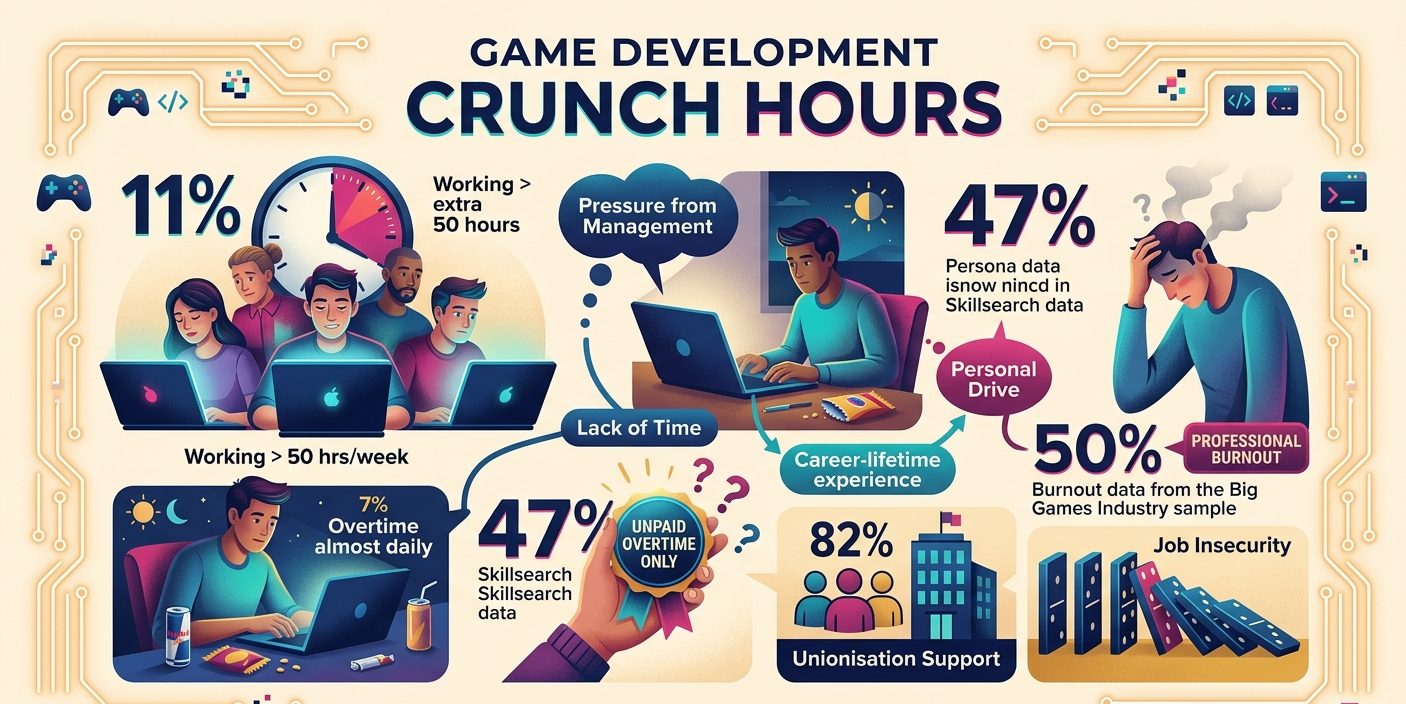
Three surveys published between 2024 and 2026 measured how long game developers actually work. The GDC State of the Game Industry 2026 puts 11% above 50 hours a week. The Big Games Industry Employment Survey 2025 records 7% working overtime almost daily. Skillsearch found 47% doing unpaid overtime only. This page sets out what each dataset measures, and where the three disagree.
Game Development Crunch Hours: Key Figures
How Many Game Developers Work Crunch Hours?
The GDC State of the Game Industry 2026 surveyed over 2,300 developers. It reports 11% working more than 50 hours in a typical week, and 59% working at least 40 hours.
A further 35% are contractors, consultants and solo developers working under 30 hours. Contract staff sit outside most overtime protections, so those hours are recorded differently from salaried studio time.
| Weekly hours reported | Share of respondents |
|---|---|
| Work at least 40 hours per week | 59% |
| Work more than 50 hours per week | 11% |
| Contractors, consultants and solo developers working under 30 hours | 35% |
Source: GDC State of the Game Industry, survey year 2026. Shares of self-selected survey respondents, not the whole workforce.
Game Development Crunch Hours Trend, 2024 to 2026
GDC’s long-hours bracket moved 8%, 13%, 11% across three editions. The bracket definition changed in 2026: earlier readings counted respondents above 51 hours, the 2026 reading counts everyone above 50.
GDC described 2025 as the first year since 2019 in which developers started working more. The wider 2026 bracket still returned a lower share than 2025.
| Survey year | Metric as GDC reported it | Share |
|---|---|---|
| 2024 | Working 40 hours or less per week | 64% |
| 2025 | Working 40 hours or less per week | 57% |
| 2024 | Working more than 51 hours per week | 8% |
| 2025 | Working more than 51 hours per week | 13% |
| 2026 | Working more than 50 hours per week | 11% |
Source: GDC State of the Game Industry, survey years 2024, 2025 and 2026. The 2026 edition uses an “at least 40 hours” framing (59%), which is not comparable with the earlier “40 hours or less” series.
Why Do Game Developers Work Crunch Hours?
Respondents could select more than one reason, so these shares overlap and cannot be added together. In the 2026 edition, 59% said there was not enough time to finish important tasks within 40 hours, and 56% cited personal drive to accomplish more.
The 2025 edition asked a different set. Two-thirds, 67%, said they worked the extra hours on their own initiative. Pressure from management was named by 12%.
| Reason given for extra hours | Share | Survey year |
|---|---|---|
| Not enough time to finish important tasks within 40 hours | 59% | 2026 |
| Personal drive to accomplish more | 56% | 2026 |
| Work the extra hours on their own initiative | 67% | 2025 |
| Do not classify the extra hours as overtime | 23% | 2025 |
| Fear of consequences | 14% | 2025 |
| Pressure from management | 12% | 2025 |
Source: GDC State of the Game Industry, survey years 2025 and 2026. Multi-select responses; 2025 and 2026 figures come from separate samples and separate question sets.
The 23% who do not classify their extra hours as overtime matter for every estimate on this page. Any measure keyed to mandated overtime misses them.
How Often Do Game Developers Work Overtime?
The Big Games Industry Employment Survey 2025, run by InGame Job with Values Value, covered 1,650 professionals across 85 countries. It measures frequency of overtime rather than total weekly hours.
Overtime happens 1–2 times a month for 22% of respondents, the largest single bucket. At the top of the range, 7% work overtime almost every day, weekends included, and 17% report never working it.
| Overtime frequency | Share of respondents |
|---|---|
| Never | 17% |
| 1–2 times a year | 13% |
| 1–2 times a quarter | 16% |
| 1–2 times a month | 22% |
| 1–2 times a week | 17% |
| More than twice a week | 8% |
| Almost every day, weekends included | 7% |
Source: Big Games Industry Employment Survey, InGame Job with Values Value, survey year 2025. Mutually exclusive frequency buckets.
Frequency and weekly-hours totals are different measurements. A developer working ten extra hours every week appears in the weekly overtime bucket here while still sitting below GDC’s 50-hour line.
The same survey found 50% of respondents reporting professional burnout. Among EU, UK and Swiss respondents, burnout ranked as the top workplace complaint at 59%.
Game Development Crunch Hours By Seniority
Weekly overtime peaks at executive level. Expert, head, chief and VP respondents report it at 43%, against 25% for senior individual contributors.
Middle-weight staff report weekly overtime more often than seniors, at 36% against 25%.
| Seniority level | Works overtime at least once a week |
|---|---|
| Expert, head, chief or VP | 43% |
| Middle | 36% |
| Junior | 30% |
| Team lead | 29% |
| Senior | 25% |
Source: Big Games Industry Employment Survey, InGame Job with Values Value, survey year 2025. Each row is a share within that seniority group, not a share of the total sample.
Are Game Development Crunch Hours Paid?
The Skillsearch Games and Interactive Salary and Satisfaction Report 2024/25 splits respondents by pay arrangement. Unpaid overtime only accounts for 47%, and paid overtime only for 14%.
Another 21% receive a mix of paid and unpaid, while 18% work no overtime at all.
| Overtime arrangement | Share of respondents |
|---|---|
| Unpaid overtime only | 47% |
| Both paid and unpaid overtime | 21% |
| No overtime worked | 18% |
| Paid overtime only | 14% |
Source: Skillsearch Games and Interactive Salary and Satisfaction Report 2024/25. Mutually exclusive categories.
Skillsearch also asked about crunch across a whole career: 43% had experienced it at some point in games, against 51% who had not. That is a career-lifetime measure, unlike the current-week measures above.
Poor mental health in the previous year was reported by 41% of the Skillsearch sample.
What Is Changing Game Development Crunch Hours?
Collective bargaining produced a documented 2025 outcome. More than 300 ZeniMax QA workers ratified a first contract with Microsoft on 24 June 2025, covering wage floors, protections against arbitrary dismissal, grievance procedures and crediting policy, according to Game Developer.
Support for that route is high in the GDC sample. Unionisation is backed by 82% of US respondents, and 62% are not members but interested. Actual membership sits at 10% in industry-wide unions, plus 2% in company unions.
Job insecurity runs the other way. GDC found 28% of respondents laid off in the past two years, rising to 33% among US respondents, with 48% of those laid off still looking for work.
An independent tracker recorded roughly 5,300 games industry layoffs in 2025.
Sources: GDC State of the Game Industry, survey year 2026; Game Developer, 24 June 2025; Game Industry Layoffs tracker, calendar year 2025.
Across three GDC editions the long-week share has read 8%, 13% and 11%. The band has not broken in either direction.
FAQs
How many hours do game developers work per week?
GDC’s 2026 survey of over 2,300 developers reports 59% working at least 40 hours per week and 11% working more than 50 hours. Another 35% are contractors or solo developers working under 30 hours.
Is crunch still common in game development?
It depends on the measure. GDC 2026 puts 11% above 50 hours weekly. The Big Games Industry Employment Survey 2025 found 7% working overtime almost daily and 17% never working it.
Do game developers get paid for crunch hours?
Often not. Skillsearch’s 2024/25 report found 47% do unpaid overtime only and 14% are paid for all overtime. A further 21% receive a mix of paid and unpaid hours.
What do game developers on Reddit say about crunch hours?
Reddit threads are anecdotal and not a measured sample, so they carry no survey weight. The closest surveyed figure is GDC 2025, where 67% said extra hours were self-initiated and 12% cited management pressure.
Which game developers work the most overtime?
Executives. In the 2025 Big Games Industry Employment Survey, 43% at expert, head, chief or VP level worked overtime at least weekly, against 25% of senior individual contributors.