
Any individual who has spent time in an arcade during the 1980s and early 1990s recalls the quiet ritual that took place before the most popular games.
A quarter placed on the edge of the game meant only one thing: someone was waiting. They were not just waiting for their turn; they were waiting for a challenge.


Arcades are loud places. The room is filled with electronic music and the sounds of games being played, along with the repetitive sound of coin slots taking another quarter and giving the player another try.
In all of that noise, there was something almost peaceful about the order that was observed. A line of quarters on the edge of the game meant only that there was someone waiting for their turn.
For players, the excitement was often traced back to beating the previous player whose score was displayed on the screen for all to see.
That name became an obsession and a marker to beat, and often it would gather attraction from people who weren’t even playing – everyone rooting for the same purpose; to get that score off the scoreboard.
Interestingly enough, this anticipation and excitement were not limited to those who played games inside the walls of the arcade.
Gaming machines had been providing excitement for decades. Long before the advent of the current technology and digital displays, people had already been fascinated by the reels and symbols on the games, analyzing the results like they are live odds pending victory.
Slot machines have always been the test of luck, and favoured just as much as any other form of gambling.
The Liberty Bell: Where It All Began
The first slot machine that represented the idea of expectation was the Liberty Bell, which was created and presented to the public by Charles Fey in 1895 in San Francisco.
It was not complicated; it had three reels that spun around when the lever was pulled and symbols like horseshoes, bells, and playing cards lined up in the middle.
The slot machine’s key component was the period of expectation prior to when the reels came to a stop and symbols aligned. People would lean forward, awaiting the reels to stop and the bell symbols to align.
The slot machine would pay out real coins, which at the time seemed like magic. Instead of having to pay the user the coins, the slot machine would pay the user automatically.
It was much like the feeling of the average arcade user when the slot machine would flash the phrase “NEW HIGH SCORE” on the screen.
Fruit Symbols and Chewing Gum Prizes
The slot machines began to change in the early twentieth century, and one of the most important slot machines designed during the era was the Mills Novelty Company’s slot machine, the Operator Bell.
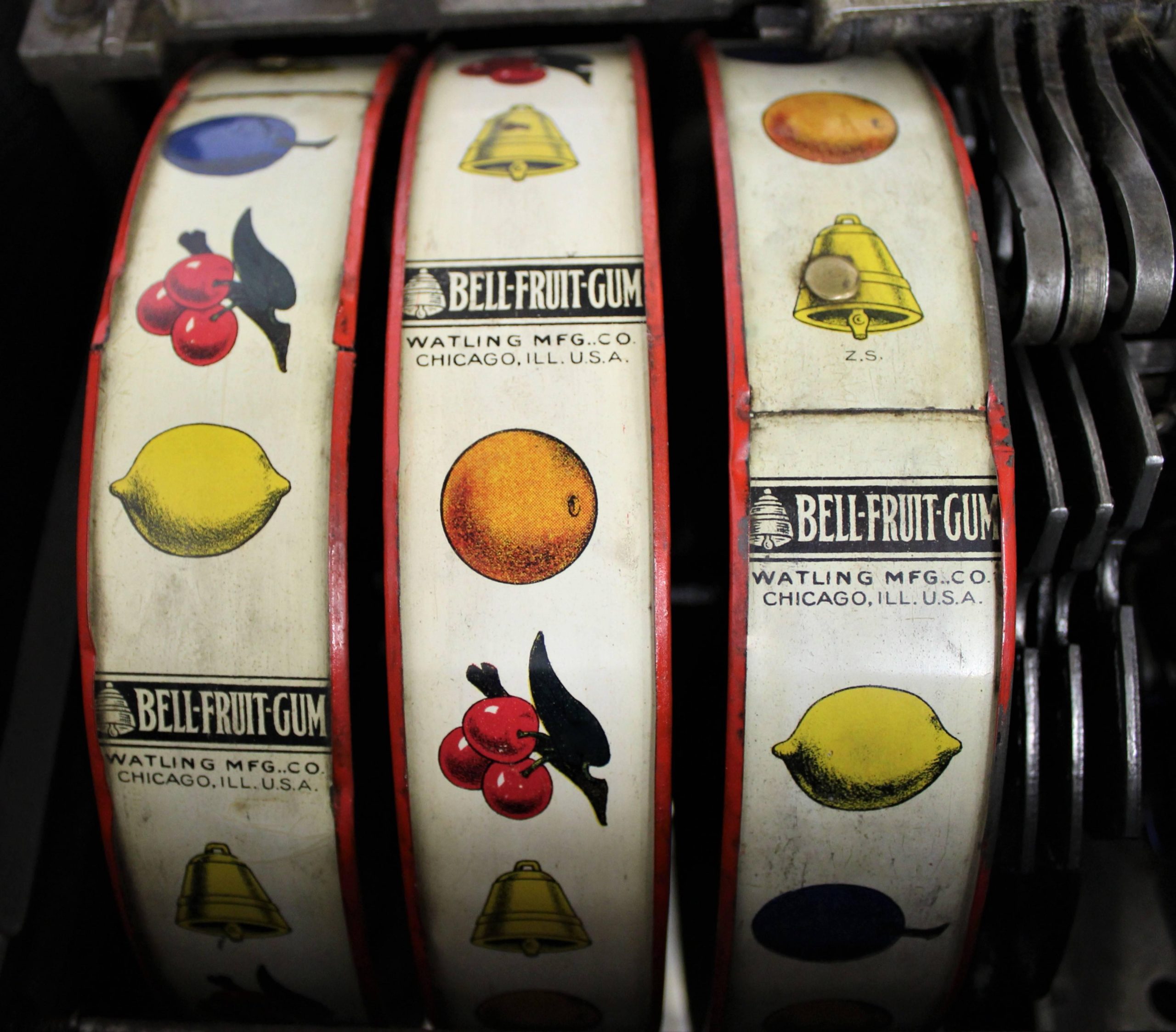
The slot machine had fruit symbols, which are still easily recognizable today. Fruits such as cherries, lemons, and plums began to appear on the slot machines.
What makes the slot machines of the era interesting, however, is the fact that the fruits did not signify the jackpot.
At the time, slot machines did not pay out the money directly, and instead, the slot machines would pay the user chewing gum. The fruit would signify the flavor of the chewing gum the user would receive.
It is one of those wonderfully odd pieces of gaming history. Symbols that millions of people now associate with casinos originally meant simple sweets dispensed from a machine.

The Sound of Mechanical Reels
The first slot machines had a personality that modern digital games do not have. When the lever is pulled, the reels do not simply spin around in silence. Instead, they have a clattering and clicking noise as they spin around inside the cabinet.
This noise has an interesting effect. Just as the electronic music found in arcade games creates an interesting effect, this noise does as well.
Some machines have a “tilt” mechanism, which is intended to prevent cheating. If the machine is tilted too hard, it locks up. The word “TILT” appears on the screen, indicating that the player has gone too far.
This system was also adopted in arcade pinball machines, showing just how closely related these gaming traditions are.
The Arrival of Electromechanical Machines
By the 1960s, technological changes were beginning to impact gaming machines again. One of the first machines to really show this change was introduced in 1963 and was called Money Honey.
This machine introduced electromechanical pieces, which allowed for more automatic payouts and more complex inner workings.
The reels still spin around as they do in earlier machines, but there is now an electronic component as well.
To the average gamer, this machine looks just as it has since the beginning. The change is occurring behind the scenes, and it is similar to changes occurring in the arcade games of the era. The change from reels to screens is about to occur.
The next leap forward came in 1976 in the form of the Fortune Coin machine. Instead of using physical reels to display results, this machine utilized a modified Sony television screen to display a series of electronic spinning symbols.
For many, this is when gaming machines finally entered the electronic age. It certainly felt like a video game experience.
What is also interesting is that this is when electronic gaming itself was taking off in arcades all over the country.
Video games like “Space Invaders” and “Pac Man” were bringing a new level of electronic gaming into arcades that had previously been dedicated to mechanical games.
Gamers that had spent countless hours trying to beat each other’s high scores on arcade games would likely have had a similar sense of excitement when playing these electronic slot machines.
Shared Roots in Gaming Culture
When looking back on the whole process, it’s amazing how closely these different forms of entertainment are connected.
Arcade games, pinball machines, and electronic slot machines had one main element in common: suspense!
Gamers would put in their quarter or press the button and then wait and wonder what would happen. Would it lead to a jackpot, or would it lead to seeing your initials on the top of the screen?
Both of these are experiences that would give the user a small sense of excitement and a feeling of community with those around you as you gathered around the screen to view and possibly compete against one another.
The Spirit of the Arcade Lives On
Today, of course, most gaming is done on a home console or computer, but you can still find a spirit of the arcade in many of the electronic slot machines that are inspired by their mechanical cousins.
Sounds may vary, and graphics may be infinitely more sophisticated, but the basic appeal remains the same.
A coin placed on a cabinet. A lever pulled on a machine. A button pressed on a controller. Each action begins with a quiet hope that the next moment might hold something special.