
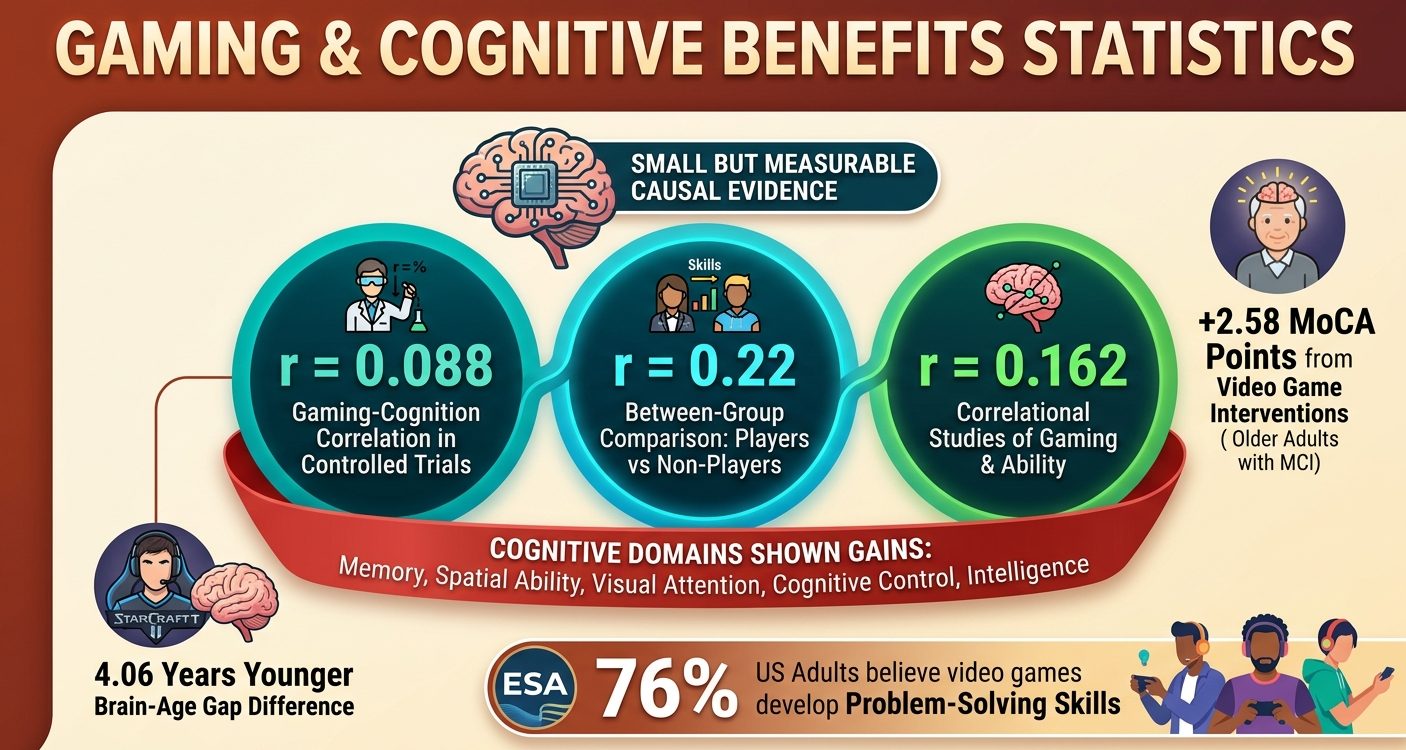
Video game play correlates with cognitive ability at r = 0.162 in correlational studies and r = 0.088 in controlled trials, according to a 2026 Acta Psychologica meta-analysis of 133 studies. This page covers gaming and cognitive benefits statistics from that review, a 2025 brain-age study, three 2026 reviews on older adults, and ESA player surveys.
Gaming and Cognitive Benefits Statistics
How Large Are the Cognitive Benefits of Gaming?
Small but measurable. A systematic review in Acta Psychologica, published online 25 May 2026, found a statistically significant positive correlation between video game play and cognitive ability in all three study designs it pooled.
The team, led by Rumei Zhao at Shanghai Normal University, analyzed 133 studies published between January 2005 and August 2025.
| Study design | Studies | Effect sizes | Participants | Pooled r |
|---|---|---|---|---|
| Correlational | 17 | 20 | 6,263 | 0.162 |
| Between-group comparison | 94 | 173 | 6,970 | 0.22 |
| Controlled trials | 22 | 76 | 1,012 | 0.088 |
| Total | 133 | 269 | 14,245 | n/a |
Between-group studies compare existing players with non-players and returned the highest correlation, r = 0.22. Controlled trials assign game play and then measure change, and EMJ describes them as the strongest causal evidence of the three designs.
In those trials, the pooled correlation stood at r = 0.088. EMJ reports that the authors called games a potential aid rather than a proven treatment and asked for more controlled trials.
Which Cognitive Domains Showed Gains?
The small correlations held for memory, spatial ability, visual attention, cognitive control and intelligence across all three designs.
None of the tested moderators changed the results: sex, age group, health condition, game type, intervention duration and cultural context.
How Reliable Are the 133 Studies?
Reviewers rated most included studies as medium quality on the Joanna Briggs Institute checklist.
4.06 Years Younger: Gaming Cognitive Benefits in Brain-Age Research
Expert StarCraft II players showed a brain-age gap 4.06 years lower than matched non-players in a Nature Communications study published 3 October 2025. Gaming produced the smallest difference of the four expert groups.
| Expert group | Country | Participants | Brain-age gap difference (years) |
|---|---|---|---|
| Tango dancers | Argentina | 46 | −7.1 |
| Visual artists | Germany | 30 | −6.2 |
| Musicians | Canada | 58 | −5.38 |
| StarCraft II players | Poland | 62 | −4.06 |
| All four groups pooled | — | 196 | −5.50 |
Negative values mean the brain clock rated experts’ brains younger than those of non-experts matched for age, sex and education.
What Changed After 30 Hours of StarCraft II?
Twenty-four beginners trained on StarCraft II for 30 hours over 3 to 4 weeks. Their brain-age gap dropped 3.06 years from before to after training.
A 12-person active control group played Hearthstone for the same hours and changed by 0.057 years, a non-significant result.
Learners raised their actions per minute (APM) by 3.83 across 20 participants. Larger APM gains went with larger brain-age reductions, at r = −0.508.
After training, learners answered the first question of an attentional blink task 141.28 milliseconds faster. The Hearthstone group showed no such effects.
What the Brain-Clock Data Cannot Show
The brain clock was trained on EEG data from 1,240 people aged 17 to 91. Its mean absolute error is 8.696 years, larger than any group difference in the study.
All 62 participants in the gaming comparison were male. Experts had played real-time strategy games at least 6 hours a week over the prior 6 months; typical play is tracked in this session length data by age group.
No EEG was recorded for the gaming group, so the authors estimated connectivity from diffusion MRI scans. Dropping gaming from the pooled analysis left the overall result unchanged.
Do Video Games Improve Cognition in Older Adults?
Three reviews published in 2026 tested games and exergames in older populations. Their results differ by population, setting and outcome measure.
Mild Cognitive Impairment: +2.58 MoCA Points
Video-game interventions raised Montreal Cognitive Assessment (MoCA) scores by 2.58 points over control conditions in older adults with mild cognitive impairment. Mini-Mental State Examination (MMSE) scores rose 1.80 points.
Completion times also fell on Trail Making Test A (SMD −1.38) and Trail Making Test B (SMD −3.50, 95% CI −6.03 to −0.98). The review pooled five RCTs with about 215 participants.
Community Exergame Programs: g = 0.135
Exergames delivered outside the lab produced a small overall cognitive benefit, Hedges’ g = 0.135 (95% CI 0.037 to 0.229). The review covered 10 RCTs and 690 participants with a mean age of 74, an age band covered in these older gamer demographics.
Global cognition on its own did not reach significance (g = 0.185). Neither did the MCI subgroup of two studies or the dementia subgroup of three.
Dementia: MoCA Gains, MMSE Not Significant
A review of nine exergame RCTs covering 717 people with dementia found a significant MoCA improvement (p = 0.007).
MMSE (p = 0.065), activities of daily living (p = 0.489) and motor function on the SPPB (p = 0.182) showed no significant effect.
Gaming and Cognitive Benefits in Children: 2022 Karolinska Data
Children who played more video games than average gained about 2.5 IQ points more than the average child between two test points. Karolinska Institutet published the result in Scientific Reports in May 2022.
More than 9,000 US children took part, first tested at age 9 or 10. They averaged 1 hour a day of gaming, 2.5 hours of TV and half an hour of social media.
TV and social media showed no significant effect, positive or negative. The analysis controlled for genetic differences in cognition and socioeconomic background.
Play patterns for 13- to 17-year-olds appear in these teen gaming habits figures.
Clinical risk from heavy play is measured separately in gaming disorder prevalence data.
How Many Players Believe Games Sharpen the Mind?
81% of weekly players in ESA’s 2025 global survey said games provide mental stimulation. The panel-recruited sample covered 24,216 players aged 16 and over in 21 countries.
Creativity (77%) and problem-solving (76%) led the skills players said games improve. Communication skills stood at 67%.
Keeping minds sharp ranked third among reasons to play, at 45%, behind fun (66%) and stress relief (58%). Emotional outcomes are covered in this gaming and mental health data.
US Adults: Essential Facts 2025 vs 2026
| Skill US adults say games develop | 2025 edition | 2026 edition |
|---|---|---|
| Problem-solving | 78% | 76% |
| Teamwork and collaboration | 69% | 67% |
| Adaptability and resilience | 60% | 58% |
| STEAM | 57% | 53% |
| Communication | 53% | 52% |
Every skill item scored lower in the 2026 edition than in 2025. The 2026 survey drew 13,545 YouGov panel respondents, weighted to the US population.
In the same 2026 survey, 79% of adults said games provide mental stimulation. Among parents whose children play, 49% said games teach skills such as problem solving and creative thinking.
ESA counts 212.3 million Americans playing weekly in the 2026 edition, and wider global player base figures are tracked separately.
Three in four US adults credit games with building problem-solving skills. Controlled trials in the Acta Psychologica review put the pooled correlation at r = 0.088.
FAQs
Do video games improve cognitive function?
Yes, by a small margin. A 2026 meta-analysis of 133 studies found pooled correlations of r = 0.088 in controlled trials and r = 0.162 in correlational studies, covering memory, attention, spatial ability, cognitive control and intelligence.
Do video games increase IQ?
A 2022 Karolinska Institutet study of more than 9,000 US children found above-average gamers gained about 2.5 IQ points more than the average child between two test points. TV and social media showed no effect.
What type of video game is best for the brain?
Game type did not change results in the 2026 Acta Psychologica review. In one 2025 trial, 30 hours of StarCraft II cut estimated brain age by 3.06 years, while Hearthstone showed no significant change.
Can video games help older adults with memory problems?
In older adults with mild cognitive impairment, video-game interventions raised MoCA scores by 2.58 points across five RCTs, per a January 2026 review. Community exergame programs showed a smaller overall effect, g = 0.135.
Is the “gaming makes you smarter” claim on Reddit backed by data?
Partly. Existing gamers outscore non-gamers at r = 0.22 in between-group studies, while controlled trials that assign play show r = 0.088, according to the 2026 Acta Psychologica meta-analysis.
Sources
https://www.sciencedirect.com/science/article/pii/S000169182600911X
https://www.nature.com/articles/s41467-025-64173-9
https://www.frontiersin.org/journals/aging-neuroscience/articles/10.3389/fnagi.2025.1756970/full
https://coopboardgames.com/statistics/teenagers-playing-video-games/
https://icon-era.com/statistics/average-gaming-session-length-by-age-group/