
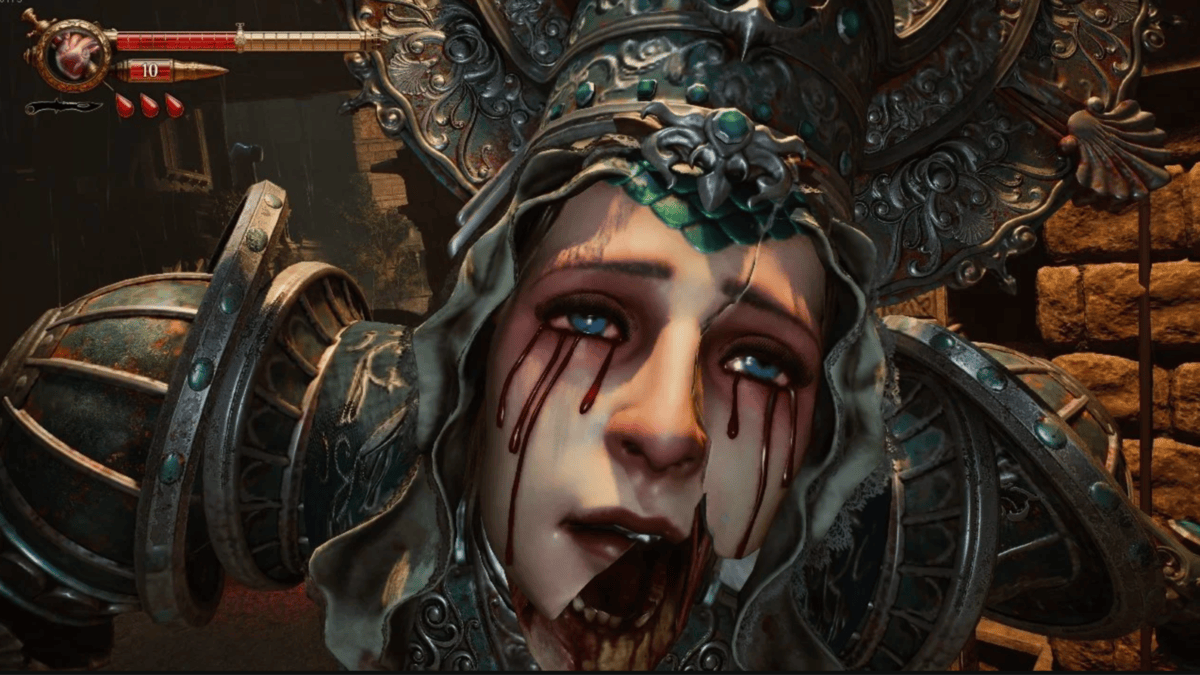
Is this Spanish indie the warm-up act we needed before Resident Evil Requiem?
There’s something genuinely intriguing about Crisol: Theater of Idols. Developed by Spanish studio Vermilla and published by Blumhouse Games, it wears its Resident Evil influence openly — and for the most part, pulls it off.
The mechanics are solid, the atmosphere has real potential, and the setting is unlike anything you’ve seen in the genre.
On paper, it had every reason to be a standout AA release. In practice, a handful of persistent design flaws and some genuinely annoying bugs prevent it from getting there.
Somewhere around the midpoint, the survival horror tension largely evaporates. What replaces it feels closer to BioShock — except without that game’s narrative confidence or forward momentum. What’s left is a stylish, moderately original action game that sits somewhere between a shooter and a survival experience.
That’s not a catastrophic outcome, but it is a different destination than the one the trailers advertised. If you go in with the right expectations, there’s a solid game here. Just not the one you might have been hoping for.
A Story That Earns Its Twists
On the surface, the premise reads like a B-movie checklist. Retired soldier Gabriel Escudero hears the voice of a god named Sol and travels to the island of Tormentosa — set in an alternate version of Spain — to prevent an ancient destroyer from awakening inside a local cathedral.
A god of fire squared off against a lord of the sea. Cultist factions on both sides. It’s familiar territory, and the game knows it.
But the more time you spend on Tormentosa, the more the story reveals itself. Themes of faith, moral ambiguity, and fallen glory start to surface, and the parallels with BioShock Infinite become hard to ignore — a supernatural city past its prime, a prophet figure hinting that everything is more complicated than it seems, a young female companion guiding you via radio, and recurring questions about what it means to believe in something.
The game isn’t subtle about its influences, but it handles them with enough care to stay genuinely engaging.
The narrative is delivered through radio conversations, short animated cutscenes between chapters, and a distinctive mechanic: 69 scripted ghost encounters scattered across the island.
These bloody spirits replay moments from the island’s past in the style of Everybody’s Gone to the Rapture, fleshing out the backstory in a way that feels authentic and budget-conscious at the same time.
The problem is pacing. Each encounter puts the brakes on an already leisurely narrative, and the cumulative effect can feel exhausting before the story finds its footing.
It’s worth noting that the game’s dark, ritualistic aesthetic — all fire gods, sea lords, and fate-driven mythology — has a lot in common with the visual language you’ll find at online casinos that lean into bold, high-stakes theming.
If that kind of atmosphere appeals to you beyond the screen, the Richard Casino promo code is worth checking out as a starting point.
Stick with it, though. The third act picks up speed and delivers a couple of genuinely powerful twists. Most of the story’s open questions get answered.
And the characters, initially flat and predictable — antagonists who are villainous, a partner who cracks jokes, a protagonist who responds in terse confusion — show surprising depth by the end. Even Gabriel earns it.
Gameplay: A Strong Foundation With a Shaky Upper Floor
The core loop will feel immediately familiar to anyone who has spent time with survival horror. Three Metroidvania-style chapters follow a corridor prologue and climax, each built around finding keys, solving puzzles, fighting animated statues, and managing consumables and upgrade items. It works. The problem isn’t the formula — it’s the inconsistency with which it’s applied.
Puzzles: Inventive Early, Recycled Late
The puzzle design shows genuine imagination, especially in the first half. You’ll find classic survival horror staples — weighing scales, clock puzzles, clues viewed through a peephole — alongside more original concepts, including a standout domino challenge and puzzles built around symbols appearing on fogged mirrors. None of it feels arbitrary, and the difficulty sits in a comfortable sweet spot.
Then the third chapter arrives and starts reusing puzzle types back-to-back, often separated by just a corridor or two.
It’s a clear sign the team ran short on ideas before they ran short on game. It doesn’t ruin the experience, but it does make the final stretch feel noticeably less inspired than what came before.
Combat: Smart Ideas, Blunted by Easy Mode Balance
The shooting is where Crisol gets most creative. Firearms are loaded using the protagonist’s own blood, creating a constant tension between spending HP to reload and preserving healing items for when you actually need them.
It’s a smart mechanic — thematic, original, and genuinely interesting in concept. In practice, the stakes rarely materialize.
Healing syringes and drainable bodies appear after nearly every enemy encounter, and the corridors leading to boss arenas tend to be lined with consumables. The resource pressure the system promises never quite arrives.
The dismemberment system is a better argument for the combat. Shoot off a statue’s arms and it drops its weapon. Take out the legs and it can only crawl. Knock off the head and it staggers, briefly disoriented.
It’s functional as well as satisfying — and the game earns a few genuine surprises through it. A legless enemy can still drag itself across the floor and stab you.
One particularly memorable moment involved an idol I’d reduced to just its lower half landing a kick on Gabriel before I registered what had happened.
Enemy variety, however, is thin. You’ll face standard idols, armored statues that split when destroyed, flying cherub snipers, stationary turrets, and Lovecraftian amphibians.
Only the amphibians feel genuinely dangerous — they burst from paintings in dark corridors and close distance fast. Everything else, including the bosses, moves slowly enough that you can almost always dictate the terms of the fight.
Melee parries with the knife exist, but shooting from a comfortable distance is almost always the better option. The knife never stops feeling like an afterthought.
Certain sections introduce a pursuer character in the vein of Lady Dimitrescu — grotesque, imposing, and initially unnerving. But Dolores is undercut by her own AI.
She regularly fails to notice Gabriel at point-blank range and tends to lose interest in the chase almost immediately. What should be a source of dread becomes a minor inconvenience.
Progression: Generous to a Fault
The upgrade system covers firearms, knives, and healing capacity, and is funded by currency looted from cash registers throughout the levels.
The problem is there’s too much of it. Experience and upgrade materials accumulate faster than you can spend them, and a bug occasionally lets you purchase upgrades for a single coin when you’re slightly short.
Combined with the already forgiving economy, any meaningful sense of resource management disappears within the first couple of hours and never returns.
Pacing: The Game’s Biggest Enemy
Crisol has a pacing problem, and it shows up in multiple forms. Empty filler rooms pad out each chapter with nothing to offer.
QTE animations move at a crawl. The third chapter introduces a motorboat sequence so slow that you’ll find yourself pressing every button on the controller looking for an acceleration option — there isn’t one.
Turning the vessel is its own ordeal. These moments don’t break the game, but in a horror title where atmosphere depends on rhythm and momentum, repeated friction like this chips away at immersion steadily and noticeably.
Where Crisol Genuinely Excels: Art Direction and Sound Design?
Vermilla spent years producing art content for larger studios on an outsourcing basis before developing Theater of Idols, and that experience is evident in every environment. The game’s visual identity is its strongest asset by a considerable margin.
Dark Spanish folklore saturates the details — gothic stone architecture, unsettling oil paintings, tarot cards in a merchant’s shop, Catholic iconography twisted just enough to feel wrong. The revived idol designs are genuinely striking, and Dolores, for all her AI shortcomings, looks the part.
Sound design is equally well-considered and plays an active role in gameplay. The creak of floorboards in an adjacent room signals approaching enemies before you see them.
The clink of coins and the cawing of crows hint at nearby collectibles. It’s the kind of audio design that rewards attention, and it elevates the overall experience beyond what the budget might suggest.
Voice acting is solid across the board. The energetic, wisecracking Mediodia is a consistent highlight, lightening the tone at just the right moments without undercutting the atmosphere. The soundtrack is the final piece — and a memorable one.
The main menu theme carries a melancholic, unsettling weight that feels like a spiritual cousin to The Witcher 3’s “Lullaby of Woe.”
The closing composition shifts direction entirely, bringing in hopeful classical Latin motifs that land with genuine emotional resonance and leave you thinking the world of Tormentosa deserved a longer story.
Final Verdict: Style Over Scares, But Worth Your Time
Crisol: Theater of Idols promised a tense, frightening survival horror experience and delivered something different — a stylish, story-driven action game with horror elements, a distinctive visual identity, and a few genuinely clever ideas. That’s not a failure. It’s a repositioning, and one that mostly works on its own terms.
The blood-as-ammunition mechanic is inventive even if it lacks bite. The narrative earns its payoff. The art direction is among the most memorable in recent indie horror.
But the broken economy, low difficulty ceiling, weak enemy AI, repetitive late-game puzzles, and sluggish pacing are real problems — not deal-breakers, but genuine friction points that patches could realistically address.
If you’re holding out for a true survival horror challenge with real tension and teeth, it’s worth waiting to see whether future updates tighten the experience.
If you’re happy with a polished, atmospheric shooter that flirts with horror without fully committing, Crisol: Theater of Idols is a confident, distinctive piece of work at an easy-to-justify price.
Quick Breakdown
What Works
- Original setting — alternate Spain with rich, distinctive dark folklore
- Engaging narrative that earns its payoff with satisfying twists
- Creative blood-as-ammo mechanic that adds thematic depth
- Solid gunplay with a genuinely satisfying dismemberment system
- Well-designed puzzles — varied and inventive, especially early on
- Exceptional art direction and environmental atmosphere
- Strong voice acting and a memorable, emotionally resonant soundtrack
- Good value for money at the current price point
What Doesn’t Work
- Budget production quality is visible throughout
- Too easy — rarely builds genuine tension or threat
- Barely scary despite the survival horror framing
- Broken economy and an over-generous upgrade system
- Weak enemy AI, including the pursuer character Dolores
- Limited enemy variety and not enough boss encounters
- The knife mechanic is largely useless in practice
- Repetitive puzzle design in the third chapter
- Sluggish animations, movement speed, and dialogue pacing drag the experience
 English
  Español de México
  Deutsch
  Español
  Italiano
  Português do Brasil