
Games used to be simple things, made by individuals or tiny teams and offering short bursts of interactive entertainment limited by the technology available at the time.
How things have changed, given that today you’ll find hundreds of new releases each year with staggeringly detailed, fully-realized worlds to explore, and complex mechanics stacked together so that everything from crafting to relationship building is possible in a single title.
Even games that have been built by armies of developers and funded by huge corporations can still flop, with player onboarding a common issue behind this failure. So, why is the first hour so often the point at which new players give up on modern games?
Too Much, Too Soon
Modern games have a two-pronged problem of having both too much story and too much technical information to convey to players in the opening hours.
That leads to a combination of interminable cutscenes and endless text boxes and tutorials, getting in the way of the actual moment to moment play.
While teaching people about the game’s world and how to interact with it are both important steps, they shouldn’t be hammered home in such detail straight away.
A game like Elden Ring does this well. It’s lore is rich and its world vast, but save for the short opening cut scene, it doesn’t bombard the player with information or guidance.
When a player can learn by doing and absorb the story through exploration rather than expositional dialogue, that first-hour drop off issue evaporates.
Of course, not all game types have this issue. Take these new Inclave casinos as an example. The games available are superficially simple, and players can get started as soon as they load.
But information about bonus modes and pay tables, as well as basic strategy and so forth, can be found in menus for those who want it.
It’s about supporting the player and giving them agency, rather than forcing everyone to go through the same first-timers onboarding experience.
Setup Annoyances and Poor Performance
Elements that are not directly related to the gameplay itself, but which do cause people to quit shortly after installing, stem from how well modern games run, as well as how they are accessed in the first place.
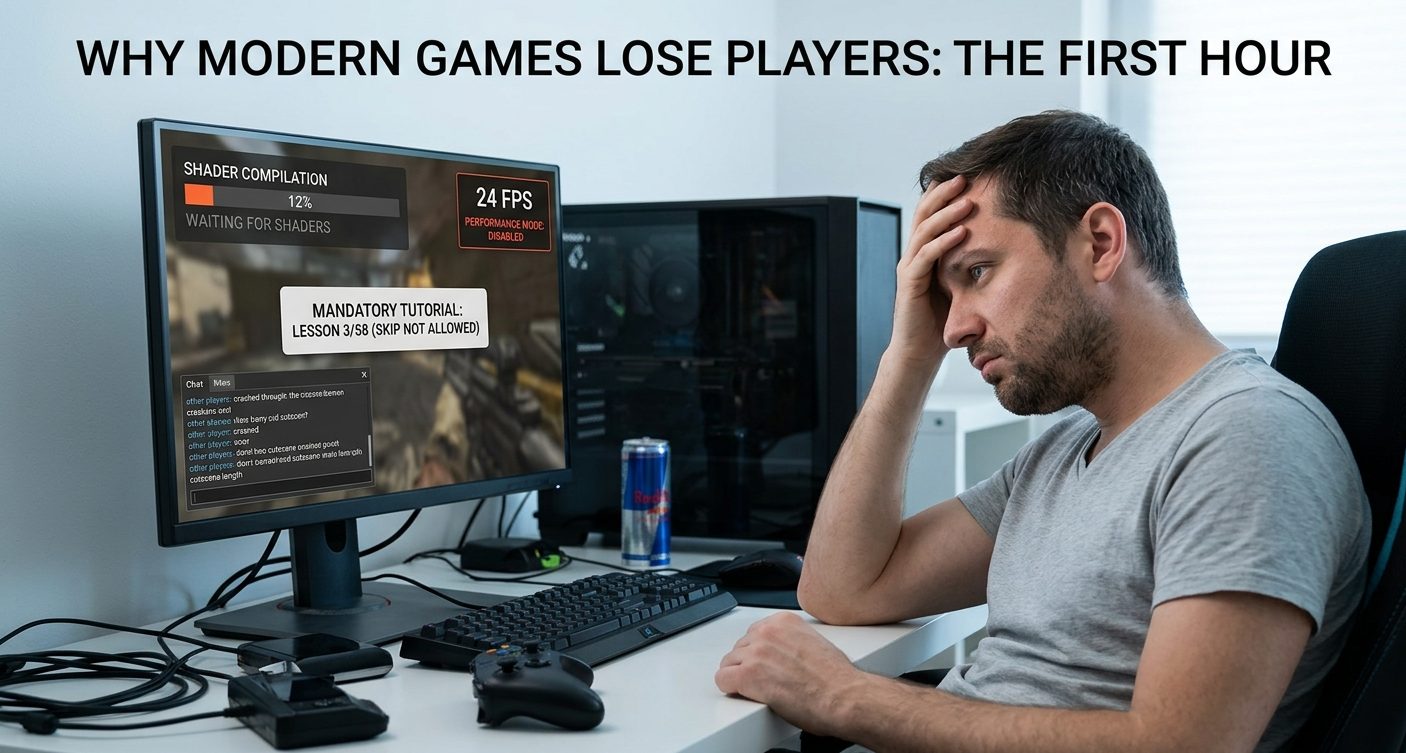
Drawn-out downloads and protracted installations, coupled with post-installation frustrations like mandatory shader compilation that can go on interminably, are a staple of the modern game experience. And while people might be prepared to put up with all this for a flagship game like GTA VI, they’re far less forgiving of an untried new IP.
Similarly, if a game is poorly optimized for the hardware running it, players won’t be happy. The PS5 and Xbox Series X era has made 60fps the benchmark, and if there’s not a performance mode available, playing at 30fps really feels sluggish.
Similarly, games becoming over-reliant on upscaling technologies to make up for poor optimization really isn’t good enough. Sure, modern games can be amazing, but the ones that lose players in the first hour should really know better by now.