
An empty column looks like progress. In Klondike, however, the space only accepts a King or a correctly ordered group headed by one. Clearing it without knowing which King can move there may leave you with less immediate freedom than the tidy board suggests.
Use the classic Klondike board on PlaySolitaire as the reference for this guide. Its seven lower columns are the working area; the four suit foundations are the destination. The example below concerns the rules of that main game, not Spider or another solitaire variant selected from the menu.
Find a destination before moving the column
A face-up card can move onto a card one rank higher and of the opposite colour. A black Seven, for example, fits on a red Eight. A correctly ordered descending group can move together, provided its top card has a legal destination.
The foundations work differently. Each begins with an Ace and builds upward in its own suit. An empty tableau column is neither a spare foundation nor a temporary parking place for any convenient card. It is specifically a destination for a King.
That restriction is part of the standard Klondike rules described by Bicycle. Before making a move that clears a column, scan the exposed cards and the playable top waste card for a King. If none is available, the new space may be useful later, but it does not make an ordinary Queen or Seven movable into it now.
Follow the whole route in a small example
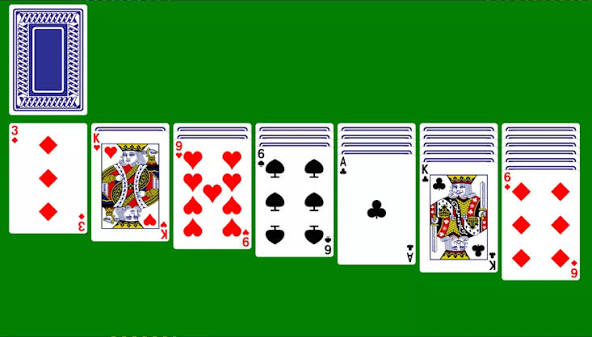
Consider an invented position rather than a complete deal. One column contains only an exposed black Seven. A red Eight is exposed in another column. Elsewhere, a red King heads a valid descending sequence consisting of a black Queen and red Jack, with a face-down card immediately behind the King.
Moving the black Seven onto the red Eight clears the first column. The King-led group can then move into that empty space. Its old column now exposes the previously hidden card, which can be turned face up.
The initial Seven move matters because it creates a legal destination for that specific group. The King move matters because it reveals a card. This is a constructed rules example, not a recorded game, a claim that the hidden card will help or a guarantee that the complete deal can be won.
Compare the Kings you can actually reach
When two Kings are available, their colours and accompanying cards may lead to different possibilities. A red King can receive a black Queen; a black King can receive a red Queen. Look at the Queens already visible before deciding which King deserves the space.
Also inspect what moving each King would uncover. One may reveal a face-down card, while another simply move a group from one open position to another. The board gives you evidence about those immediate consequences. It gives no evidence about the identity of a card that is still hidden.
A King under another face-up card is not automatically available. The covering card or sequence first needs its own legal destination. Planning an empty column around an unreachable King skips the very move that must make the plan possible.
Keep the two kinds of progress separate
Arkadium’s Klondike instructions also distinguish building the foundations from rearranging tableau groups. A move that sends a card upward can look productive while removing a receiving card that another visible card still needs.
Return to the reference board and identify the intended result before moving: a legal place for the King, an exposed hidden card or a route for a waiting Queen. Those are concrete changes you can check. A visually cleaner arrangement is not a separate win condition.
The aim remains to complete all four foundations from Ace to King. An empty column is useful when it contributes to that task. Find the King, inspect the route and judge the card it reveals only after you can actually see it.