
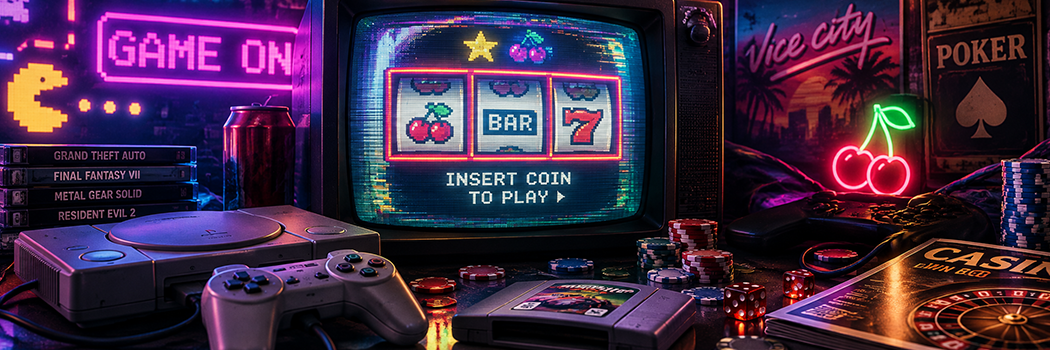
Just think over all video games released in the late 1980s and early 1990s – nearly each had a sort of casino level.
Sometimes they were bonus stages, and sometimes separate modes or missions. Take the timeless classic Super Mario Bros. 3 (1988) by Nintendo, for example, where you could win extra lives in slots between levels – and that is just one of many examples.
Online casinos did not even exist when gambling elements first appeared in video games. Those colourful blinking things were somewhat authentic and alluring – something that attracted players worldwide.
In this post, we explain why casino levels were everywhere in video games and why they (and their modern variations) still resonate with users.
The Need for Visual and Thematic Variety
Game developers needed a new, fun setting that could contrast with the game’s main locations and entertain users – something easy to implement, something that keeps the player busy. Casino levels ended up being just the right fit.
Brightness, neon, and glamour, typical for physical casinos, moved to gameplay and literally occupied home consoles in the 90s and early 00s.
Gradually, the industry began moving away from pixelated images toward 2D rendering and pinball hybrids, first with slot-like levels in Sega or Squaresoft games.
Of course, those iterations were mostly simplified. Meanwhile, they helped make the game world brighter, more captivating and attractive to users worldwide.
Casino Night Zone in “Sonic the Hedgehog 2” (1992) pretty much confirms that. The main levels led users through Emerald Hill, Chemical Plant, and Aquatic Ruin. Then, you could reach the Night Zone, and that was a huge step in visual aesthetics and luxury.
It’s literally the city of neon that never sleeps. Closer attention to the background: it displays the most recognisable and real spots on the Las Vegas Strip, such as the Holiday facade. Fictional, glowing casinos rose nearby with bright signs – Sonic and Sega.
A step inside immerses the user in spacious rooms with pinball tables, wheels of fortune, bumpers and other casino features. As soon as Sonic jumps into a slot, the reels start spinning, promising up to 999 rings for winning combos.
A cracking detail: Japanese video game designer Rieko Kodama initially created Casino Night Zone. But as she wasn’t familiar with the casino atmosphere, she couldn’t make the location realistic. So her colleague Yasushi Yamaguchi did everything from scratch. The interior and all those glittering details that add charm to “Sonic the Hedgehog 2” are his merit.
Casino Mechanics Were Cheaper to Develop
Adding a minigame, a special level, or an integrated casino-style location to a platformer wasn’t challenging for retro game developers.
Random reward mechanics and attractive bonus content have always had a bunch of fans. The idea didn’t cost a fortune, plus realisation required no complex coding or lengthy preparation.
Even if the casino level and the main gameplay didn’t match in design, these stages/modes were never perceived as something alien.
It was just a trick: developers could keep players glued to the product at minimal cost, and players could earn extra lives or resources. While such mini-games were part of an expensive overall production, they didn’t drain the budget.
Sure thing, the industry improved, and every step in development and packaging required more finances over time.
Developers paid through the nose for advanced 3D graphics and for building multiple engines within one level. Take at least the Gold Saucer level in Final Fantasy VII (1997). That’s an iconic casino location with several gambling mechanics:
- Wonder Catcher, described by fans as “most akin to a Vegas slot machine,” because winning prizes was far from easy.
- The “slots trick” in Battle Square turned out to be a way to accumulate battle bonuses.
- Cait Sith’s Limit Break also uses a similar mechanic, but it becomes part of the character’s identity while still operating on slot logic.
Compared to one bonus stage, such a high concentration of interactive attractions required extra programming effort and, as a result, extra finances. Square Enix (formerly Square) spent $45 million on Final Fantasy VII – an unprecedented budget allocated for a video game project in 1997.
Growing Open Worlds Made Casinos a Natural Fit
Fictional worlds pass through industrial areas, simulate cities, and include natural locations. Casinos, as part of the reality that inspired video game developers, also made their way into gameplay.
In GTA: San Andreas (released in 2004 for PlayStation 2, Xbox, and PC), we saw Las Venturas – a city modelled after Las Vegas. And what would Las Vegas be without poker tables, roulette, blackjack, and other casino staples?
The creators of the famous open-world simulation thought the same way, so it was only logical for Four Dragons Casino, Caligula’s Palace, and Casino Floor to become part of the location. You could not only visit each of them but also play there using in-game currency within the ecosystem.
Due to realistic gameplay, slot machines are perhaps the key selling point in Las Venturas establishments. You place a wager, pull the handle to spin the reels and receive an entirely random result.
Today, people do not need to play a video game to test three-reel setups – they are a tap away. Plenty of free slots UK sites let retro gaming fans spin reels in a browser (both on desktops and mobile devices).
Moreover, this sandbox-style game went even further: its creators added casino heists to the storyline. The only difference from reality is that you don’t have to rob a casino – you can borrow in-game money from it.
However, if the character fails to pay it back, there are consequences. Overall, players spent hours at the local gaming establishments without even touching other missions.
Why Casino Levels Still Resonate With Players Today?
Retro games with casino elements from the 90s and early 00s have nurtured modern UK gaming culture. Fans love these gameplay details because the free-to-play format lets them obtain valuable resources, level up their characters, or earn in-game currency.
To a large extent, gaming nostalgia makes us return to the projects that the boomer generation relaxed with and that shaped millennials.
These video games offered more than just completing levels – here, you could add some excitement, draw a lucky card, or make a successful jump into a slot and get a boost.
And even now, with browser-based gaming and hundreds of titles with Gachas and Lootboxes for PC, Nintendo, or Xbox, we still love the classics where it all began.